
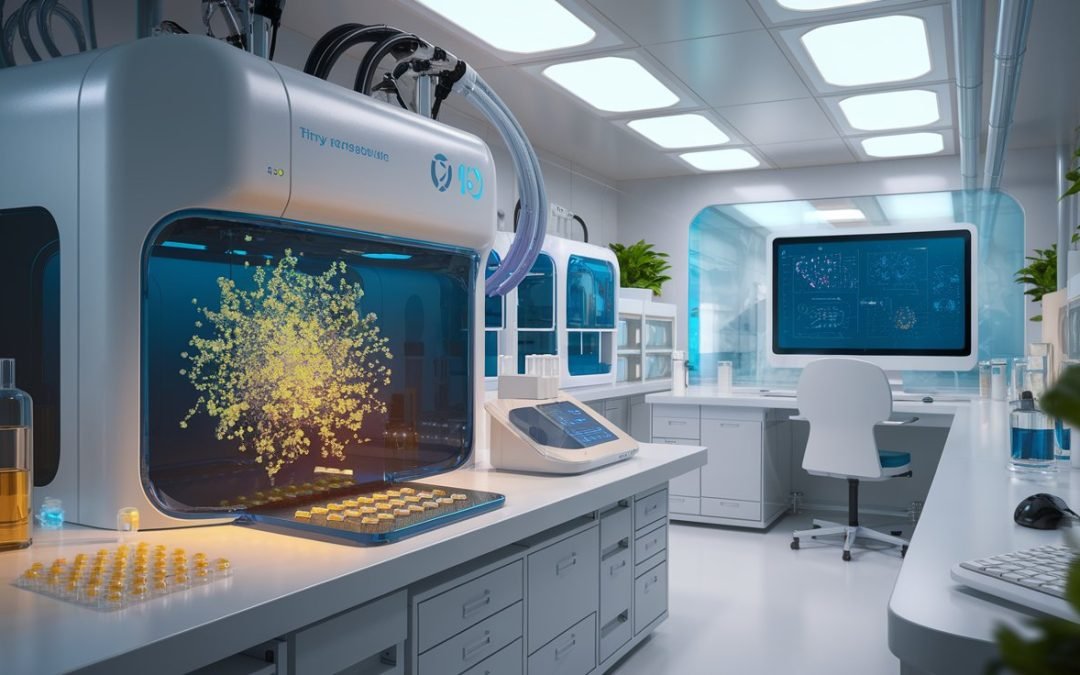
The pharmaceutical landscape is undergoing a profound transformation, with revolutionary approaches to drug development and manufacturing emerging at an unprecedented pace. At the heart of many of these innovations lies an often-overlooked component: solvents. These essential chemicals, traditionally viewed as mere processing aids, are evolving into sophisticated tools that actively contribute to drug efficacy, manufacturing efficiency, and environmental sustainability.
As a specialized chemical distributor serving the European pharmaceutical industry, ChemComplex understands that access to cutting-edge solvents is crucial for manufacturers developing next-generation medicines. This article explores the groundbreaking technologies revolutionizing solvent use in pharmaceutical development and how these innovations are shaping the future of medicine.
Continuous Manufacturing: Revolutionizing Production Workflows
The traditional batch manufacturing model for pharmaceuticals is giving way to a more efficient approach: continuous manufacturing. Rather than producing medicines in discrete batches, continuous manufacturing creates an uninterrupted flow where raw materials enter one end of the process and finished medications emerge from the other.
This revolutionary approach has gained significant industry momentum. Major pharmaceutical companies including Pfizer, Eli Lilly, and GSK have embraced continuous manufacturing, resulting in the approval of over half a dozen medicines in the U.S. using this methodology. The benefits are substantial:
- Production time reduction of up to 90%
- Facility footprint decreased by 50-70%
- Significant waste reduction
- Enhanced quality control through real-time monitoring
- Greater flexibility in production volumes
Advanced solvent systems play a crucial role in continuous manufacturing success. These processes require solvents with:
- Exceptional stability under extended processing conditions
- Precisely tuned viscosity and flow characteristics
- Carefully balanced solubility parameters
- Minimal environmental impact for sustainable operation
These specialized solvents function as the literal “flow” in flow chemistry, carrying reactants and products through the continuous process while maintaining optimal conditions for each reaction stage. As continuous manufacturing continues to gain regulatory acceptance, the demand for these advanced solvent systems will only increase.
3D Printing: Personalized Medicine Becomes Reality
Perhaps no recent innovation better represents the future of pharmaceutical production than 3D printing technology. This revolutionary approach allows for unprecedented customization of dosage forms, creating personalized medicines tailored to individual patient needs.
The milestone in this field occurred in 2015 when Aprecia Pharmaceuticals received FDA approval for SPRITAM, the first 3D-printed medication. This breakthrough product demonstrated how 3D printing could create rapid-dissolving formulations that deliver precise doses, particularly beneficial for patients with difficulty swallowing conventional tablets.
The solvent systems enabling 3D-printed pharmaceuticals must meet extraordinary requirements:
- Rapid solidification properties after deposition
- Precise rheological characteristics for accurate printing
- Biocompatibility without residual toxicity concerns
- Stability during the printing process
- Ability to maintain API integrity throughout processing
These specialized solvent systems act as both carriers and structural components in 3D-printed medications. As this technology continues to evolve, we anticipate the development of increasingly sophisticated solvent formulations designed specifically for various 3D printing methodologies, from fused deposition modeling to stereo-lithography approaches.
Nanotechnology: Precision Delivery at the Molecular Level
Nanotechnology represents a quantum leap in drug delivery, enabling pharmaceutical compounds to reach previously inaccessible targets with unprecedented precision. This approach utilizes engineered particles typically between 1 and 100 nanometers in size—so small that hundreds could fit across the width of a human hair.
Advanced delivery systems including nanoparticles, liposomes, and nanoscale polymer constructs are revolutionizing how medicines interact with the body. These systems depend on specialized solvent technologies to:
- Enhance solubility of poorly water-soluble drugs
- Stabilize delicate nanostructures during manufacturing
- Control particle size distribution with exceptional precision
- Enable surface functionalization for targeted delivery
- Maintain stability during storage and administration
The solvents employed in nanomedicine production must balance seemingly contradictory properties: they must solubilize hydrophobic compounds while allowing controlled assembly into nanostructures. They must facilitate precise engineering of particle characteristics while remaining biocompatible and easily removed from final formulations.
The next generation of nanomedicine solvents includes designer systems specifically engineered for particular nanoparticle types. These might include:
- Microemulsion precursor systems that spontaneously form defined nanostructures
- Phase-separating solvent mixtures that enable controlled precipitation
- Biocompatible deep eutectic solvents derived from natural sources
- Supercritical fluid technologies for residue-free processing
As nanomedicine continues its rapid growth, the specialized solvents enabling these technologies will become increasingly sophisticated and purpose-designed.
In Situ Gel Systems: Smart Materials with Perfect Timing
In situ gelling systems represent an elegant solution to a challenging pharmaceutical problem: how to administer a medication as a convenient liquid that then transforms into a controlled-release gel exactly where needed in the body. These innovative formulations undergo a phase transition triggered by specific biological conditions such as temperature, pH, or the presence of certain ions.
Natural and synthetic polymers form the backbone of these systems, creating unique drug delivery solutions for applications ranging from ocular treatments to injectable depots. Silicone microsphere hydrogels, for instance, offer remarkable gastroprotective properties through their ability to form protective barriers at targeted sites.
The solvent systems enabling these smart materials must demonstrate exceptional sophistication:
- They must maintain polymers in solution until the desired trigger point
- They need biocompatibility appropriate for their administration route
- They must facilitate rapid and complete phase transition under specific conditions
- They require stability during storage while maintaining responsiveness to biological triggers
These advanced solvent systems don’t merely dissolve active ingredients—they actively participate in the material’s functional behavior, enabling its transformation from one physical state to another in response to biological cues. This represents a fundamental shift in how we conceptualize solvents in pharmaceutical applications, from passive carriers to active participants in therapeutic function.
Higher Selectivity in Drug Administration: Precision Medicine
The future of pharmaceuticals lies in precision—delivering the right medicine to the right tissue at the right time. Emerging drug administration methods prioritize selectivity, aiming to maximize therapeutic effect while minimizing systemic exposure and side effects.
Advanced solvent systems are central to achieving this enhanced selectivity through several mechanisms:
- Tissue-specific solubility: Solvents engineered to preferentially partition into target tissues
- Environment-responsive behavior: Systems that release active compounds only under specific physiological conditions
- Permeation enhancement: Solvents that temporarily and selectively enhance membrane permeability
- Co-solvent systems: Precisely balanced mixtures that maintain drug solubility until reaching target sites
These specialized solvent approaches can dramatically improve therapeutic index—the ratio between a drug’s effective dose and its toxic dose—by ensuring active compounds reach their intended targets while minimizing exposure to other tissues. The result is medicines with improved efficacy and reduced side effects.
Controlled Release and Targeted Delivery: Perfect Timing, Perfect Place
Controlled release technology has evolved from simple extended-release formulations to sophisticated systems capable of precisely timing drug delivery based on chronobiological factors—delivering medications when they will be most effective based on the body’s natural rhythms.
Similarly, targeted delivery has progressed from basic approaches to advanced systems capable of recognizing specific cell types or physiological environments. Both developments rely heavily on innovative solvent technologies:
- Chronotherapeutic solvents: Systems that modulate release based on time-dependent factors
- Microstructured solvent systems: Creating complex internal architectures that control diffusion rates
- Stimuli-responsive solvent matrices: Materials that alter release rates in response to specific triggers
- Biomimetic solvent complexes: Systems that mimic natural transport mechanisms
These advanced approaches represent a significant departure from traditional pharmaceutical solvents. Rather than serving merely as processing aids during manufacturing, these sophisticated systems remain active components of the final drug product, continuing to perform functional roles throughout the medication’s therapeutic journey.
Chemistry, Manufacturing, and Controls (CMC): Efficiency Through Innovation
The Chemistry, Manufacturing, and Controls framework encompasses all aspects of pharmaceutical production, from raw material selection through final product release. Within this framework, solvent innovation offers tremendous untapped potential to streamline manufacturing processes.
Next-generation manufacturing approaches leverage advanced solvent technologies to:
- Reduce process steps through multifunctional solvent systems
- Enable atom economy through improved selectivity
- Facilitate process intensification through optimized reaction conditions
- Improve quality control through enhanced process understanding
- Reduce environmental impact through greener chemistry approaches
The solvents enabling these improvements often feature molecular designs specifically tailored to particular chemical transformations or separation processes. Far from generic chemicals, these specialized tools are increasingly becoming intellectual property assets in their own right, conferring competitive advantages to companies that develop and deploy them effectively.
The Future of Pharmaceutical Solvents: Beyond Traditional Boundaries
As we look toward the horizon of pharmaceutical development, several emerging solvent technologies show particular promise:
Switchable Solvents: Transformation on Command
Switchable solvents represent a fascinating frontier in solvent technology. These innovative systems can transform their fundamental properties—such as polarity, hydrogen bonding capacity, or miscibility—in response to external triggers like CO₂ pressure, light, or electrical stimulation.
For pharmaceutical applications, this means a single solvent system could:
- Act as an excellent reaction medium during synthesis
- Transform to facilitate product separation
- Convert again for easy solvent recovery
- Change once more for environmentally friendly disposal
This remarkable versatility could dramatically simplify manufacturing processes while reducing solvent consumption and waste generation.
Designer Ionic Liquids: Solvents Built from Scratch
Ionic liquids—salts that remain liquid at room temperature—offer unprecedented opportunities for solvent customization. By selecting from thousands of possible cation and anion combinations, scientists can design solvents with precisely tailored properties for specific applications.
Pharmaceutical applications benefit from ionic liquids that feature:
- Negligible vapor pressure, eliminating inhalation exposure
- Thermal stability across wide temperature ranges
- Ability to dissolve compounds insoluble in conventional solvents
- Antimicrobial properties that can enhance product stability
- Biodegradability for environmental sustainability
As this technology matures, we anticipate seeing ionic liquids designed specifically for particular pharmaceutical processes or drug delivery systems.
Deep Eutectic Solvents: Nature-Inspired Solutions
Deep eutectic solvents (DES) represent one of the most exciting recent developments in green chemistry. These systems form when hydrogen bond donors interact with hydrogen bond acceptors, creating mixtures with melting points far below those of the individual components.
Particularly promising for pharmaceutical applications are natural deep eutectic solvents (NADES) derived from plant metabolites, sugars, amino acids, and other naturally occurring compounds. These systems offer:
- Exceptional biocompatibility
- Low toxicity profiles
- Biodegradability
- Ability to dissolve both polar and non-polar compounds
- Tunable physicochemical properties
As pharmaceutical manufacturing emphasizes sustainability, these nature-inspired solvents will likely play an increasingly important role in tomorrow’s medicines.
Conclusion: Solvents as Strategic Assets
The evolution of pharmaceutical solvents from commodity chemicals to sophisticated functional materials represents a fundamental shift in how the industry approaches drug development and manufacturing. These advanced systems are becoming strategic assets that enable innovative drug delivery approaches, more efficient manufacturing processes, and improved therapeutic outcomes.
As a specialized chemical distributor, ChemComplex is committed to providing European pharmaceutical manufacturers with access to high-quality solvents that meet the demanding requirements of cutting-edge drug development. Our carefully curated product portfolio includes both traditional pharmaceutical solvents and emerging alternatives designed for next-generation applications.
While our primary focus is the pharmaceutical industry, our expertise allows us to offer premium chemical products to diverse sectors including Agrochemicals, Coatings & Construction, Personal Care & Cleaning Solutions, Oil & Gas, Water & Metal Treatment, and Battery technologies.
The future of medicine will be shaped in part by these innovative solvent technologies. Companies that recognize their strategic importance and select appropriate systems for their specific applications will be well-positioned to develop the breakthrough therapies of tomorrow.
Experience the precision of pharmaceutical-grade distribution with the convenience of a comprehensive chemical supplier. Contact ChemComplex today to discuss how our high-quality solvents can support your pharmaceutical innovation initiatives.