
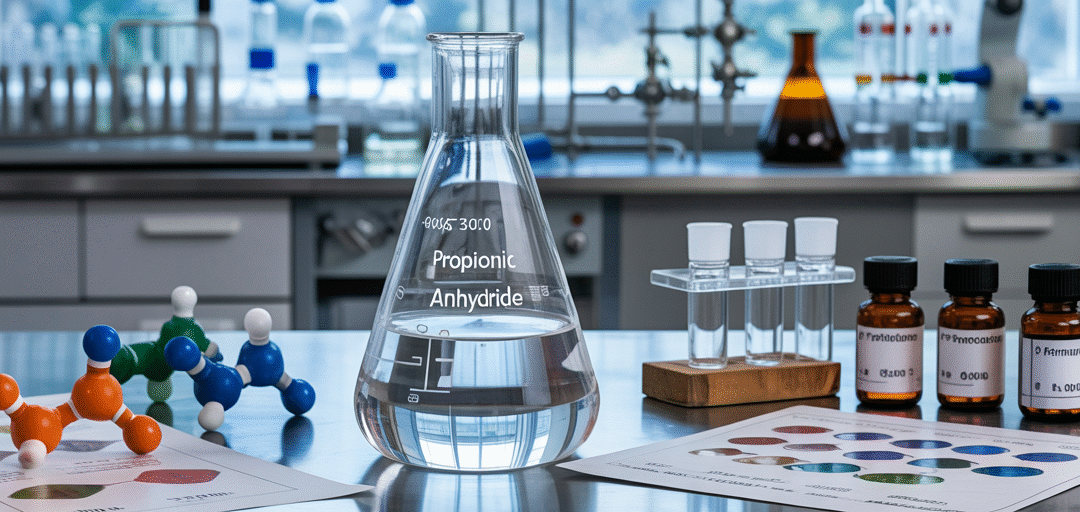
Propionic anhydride is one of those behind-the-scenes reagents whose influence stretches far beyond its modest profile. In the lab it is the propionylating workhorse that turns alcohols and amines into propionate esters and amides; in industry it is a gateway into antihistamines, corticosteroid esters, cellulose propionate plastics, herbicide actives, and flavour ingredients. The molecule also sits at the crossroads of several strategic trends: the post-pandemic normalisation of pharmaceutical supply chains, ongoing demand for crop-protection intermediates, and the pivot to bio-based feedstocks. At the same time, regulators are turning a sharper eye to acylation chemistry—tightening controls on certain chlorinated routes and on listed drug-precursor chemicals—forcing buyers to balance performance, compliance, and sustainability.
This technical primer walks through how propionic anhydride is made, why it is prized across sectors, which greener routes are moving from pilot to plant, and what safety and regulatory signals matter for procurement and formulation teams over the next five years.
What It Is and Why It Matters
Chemically, propionic anhydride is the symmetrical anhydride of propionic acid: a colourless, pungent liquid that hydrolyses in water back to the acid. Functionally, it is a high-energy acylating agent. Compared with propionic acid, the anhydride reacts faster and under milder conditions, which is why it is favoured to:
Esterify alcohols to generate propionate esters (fragrance and flavour notes; plasticiser intermediates; cellulose propionate).
Acylate amines and activated aromatics in the synthesis of pharmaceutical intermediates (e.g., propionylated side chains in antihistamine families and steroid esters).
Serve as a dehydrating/activating agent in certain nitrations and sulfonations (process chemistry).
From a market perspective, the demand profile is diversified: pharmaceuticals and agrochemicals carry the highest value density, while flavours, fragrances, lubricants and specialty resins add breadth. Producer technical data sheets and application brochures consistently flag these end-uses, and public databases list propionic anhydride as a key esterifying reagent and raw material for cellulose derivatives.
How It’s Made: Industrial Production Routes That Matter
Although many lab routes exist, three industrially relevant pathways dominate discussions today—each with its own feedstock logic, impurity risks and decarbonisation potential.
1) Ketene-Mediated Anhydride Formation
A classic approach passes ketene (CH₂=C=O) into propionic acid, giving propionic anhydride and acetic acid as a coproduct via mixed-anhydride rearrangements. The unit operation can be continuous and integrates well with acetic-ketene trains. Historical patents and process descriptions document vapour-phase dehydration and reactive distillation schemes, while modern producers tune conditions to minimise coloured by-products and tar.
Why it endures: high space–time yields and ready integration wherever ketene is already on site (for acetic anhydride or cellulose ester value chains).
What to watch: ketene generation routes (thermal cracking of acetic acid or acetone) and energy intensity; impurity carryover (peroxides, aldehydes) that matters for pharma-grade supply.
2) Direct Dehydration/Carbonylation Variants
Steam-strip or azeotrope-assisted dehydration of propionic acid can form the anhydride, frequently in the presence of entrainers and catalysts; carbonylation-type routes (Reppe chemistry) are also described in the literature, coupling ethylene, CO and propionic acid under metal catalysts to deliver propionic anhydride.
Why it’s interesting: avoids separate ketene units; potential to plug directly into bio-propionic acid tanks if fermentation capacity scales.
What to watch: catalyst costs and robustness; separation trains to hit pharma-grade impurity profiles.
3) Anhydride Exchange/Reactive Distillation
Process patents describe reactive distillation between acetic anhydride and propionic acid to bias equilibria toward propionic anhydride while removing acetic acid overhead. This “mixed anhydride shuffle” is attractive wherever acetic anhydride is abundant and low-cost.
Why it’s attractive: flexible route using existing bulk anhydrides; good platform for process intensification.
What to watch: corrosivity management in the column; downstream polishing of colour and acidity for sensitive applications.
Table 1 — Industrial Routes to Propionic Anhydride (Illustrative Comparison)
| Route | Typical feedstocks | Key coproducts/by-products | Process notes | Decarbonisation upside |
|---|---|---|---|---|
| Ketene + propionic acid | Acetic acid/acetone → ketene; propionic acid | Acetic acid; light condensables | Continuous gas–liquid contact; reactive distillation options | If ketene comes from bio-acetic or renewable heat, meaningful |
| Direct dehydration | Propionic acid (fossil or bio) | Water; traces of coloured oligomers | Azeotrope/entrainer use; catalyst variants | Strong if propionic acid is bio-based |
| Carbonylation (Reppe-type) | Ethylene, CO, propionic acid | Minimal (water) | Catalyst life and poison control critical | Bio-ethylene + bio-PA feed enable large CO₂ cuts |
| Anhydride exchange | Acetic anhydride + propionic acid | Acetic acid overhead | Intensified column; multiple take-offs | Dependent on upstream anhydride footprint |
Notes: public patents, producer brochures and database entries corroborate these routes; exact catalysts and conditions vary by licensee and site.
Application Map: Where the Value Is
Pharmaceuticals and Intermediates
Propionic anhydride propionylates amines and phenols en route to antihistamines, analgesics and steroid esters (e.g., betamethasone dipropionate), as well as myriad API side-chains and protecting-group strategies. It also appears in peptide and small-molecule process steps as an acylating/dehydrating adjunct when milder reagents underperform.Agrochemicals
Crop-protection value chains use propionic anhydride to build propionate-bearing herbicides and safeners (e.g., within the clethodim family and related grass-control chemistry), and as a propionylating agent in the synthesis of esterified phenoxy acid derivatives.Cellulose Propionate & Specialty Polymers
Esterification of cellulose with propionic anhydride yields cellulose acetate propionate (CAP)—a tough, transparent thermoplastic used in optical frames, face shields, tool handles and premium packaging. Propionic anhydride’s faster kinetics and lower side-reactions vs acid routes help reach low-colour, high-molecular-weight CAP.Flavours & Fragrances
Propionate esters impart fruity, creamy and buttery notes; propionic anhydride is the esterifying agent of choice for many of these, thanks to clean conversions, short cycle times and straightforward work-ups.Process Roles
As a dehydrating/activating agent, propionic anhydride appears in nitrations and sulfonations, in acyl-transfer steps, and—in some niche cases—in lubricant additive synthesis and ink-resin finishing.
Table 2 — Sector Uses and Formulation Cues
| Sector | Typical function | Formulation/process cue | Procurement note |
|---|---|---|---|
| Pharma (small molecules; steroids) | Propionylation, esterification | Control moisture rigorously; quench design to minimise residual acidity | Prefer low-colour, low-peroxide lots; pharma-grade CoAs |
| Biotech/process | Acylation adjunct; protecting group chemistry | Choose solvent systems that buffer exotherm on addition | Supplier change-control essential for filings |
| Agrochemicals | Side-chain introduction; ester formation | Scale for heat removal; neutralise consistently for downstream crystallisations | Batch consistency drives impurity profile control |
| Cellulose derivatives | Cellulose propionate manufacture | Continuous esterification with rigorous water removal | Corrosion-resistant metallurgy; acid scavengers |
| Flavours & fragrances | Esterification | Ensure odour profile isn’t compromised by trace acids | Food/flavour grade where required |
Safety, HSE and Handling Essentials
Propionic anhydride is corrosive and combustible with a flash point in the mid-60s °C. It reacts exothermically with water, and the hydrolysis generates propionic acid, which can intensify corrosion. Vapours are irritating to the eyes and respiratory tract. Storage therefore revolves around:
Dry, closed systems, inerted where feasible, with water exclusion and slop/vent scrubbing for acid vapours.
Acid-resistant metallurgy (e.g., 316L with proper passivation; glass-lined where necessary).
Careful addition control during charging—especially into basic or nucleophile-rich media—so the acylation exotherm stays inside the cooling envelope.
Emergency planning for spills: absorbents compatible with acids; no direct water streams on bulk liquid; trained first-aid for eye and skin exposure.
Authoritative SDS and international safety cards catalog hazard classes, UN numbers (UN 2496; Class 8, PG III), and PPE expectations (goggles/face shield, acid gloves, chemical suit, A-type respirators for organic vapours where required).
The Regulatory Spotlight: Controls and “Chloro-Routes”
Listed-chemical status (United States)
Propionic anhydride is a List I chemical under the U.S. Controlled Substances Act with very low threshold quantities, reflecting its potential misuse in illicit synthesis. That designation triggers registration, record-keeping and import/export licensing requirements for operators. Parallel U.S. rulemaking in 2025 proposed bringing propionyl chloride—a closely related acyl chloride—under List I controls as well, signalling tighter oversight of chloro-acyl reagents.
EU drug-precursor regime
Within the EU, drug precursor legislation (Regulation (EC) No 273/2004 and related texts) imposes licensing, customer-due-diligence and record-keeping on operators handling scheduled substances and sets out inspection frameworks. Universities and research operators are explicitly reminded that the rules apply even where there is no “trade” per se. While acetic anhydride is the poster child in Category 2, the overall framework and national implementations shape how European buyers manage propionic anhydride transactions and custody.
Why the focus on chloro-routes?
Acid chlorides (e.g., propionyl chloride) are highly reactive and release HCl on use; they can create more problematic chlorinated waste streams and carry greater acute-exposure risks. Where process chemistry allows, many sponsors prefer anhydrides (like propionic anhydride) or activated esters to reduce corrosive off-gassing and to simplify worker-exposure controls. The U.S. move to list propionyl chloride underscores this trend.
Buyer’s takeaway: Expect more rigorous customer vetting, declarations of end-use, and at-border scrutiny for propionylating agents. Build compliance into your lead-time assumptions and documentation packs.
The Sustainability Angle: From Bio-Propionic Acid to Bio-Anhydride
If the world wants greener anhydrides, it must start with greener acids or low-carbon carbonyl sources.
Bio-based propionic acid (PA).
Multiple groups and reviews document fermentation of carbohydrates or crude glycerol into propionic acid using Propionibacterium and related strains. Techno-economics have historically been tight, but continuous fermentation, in-situ product removal (extraction, membrane processes) and low-cost feedstocks (biodiesel glycerol) are changing the calculus. If bio-PA is available at competitive cost and impurity spec, direct dehydration or anhydride exchange can convert it to bio-attributed propionic anhydride.Carbonylation routes with bio-ethylene and low-carbon CO.
Where Reppe-type chemistry is used, sourcing bio-ethylene (from bio-ethanol dehydration) and low-carbon carbon monoxide can reduce scope-3 emissions. The limiting step is often catalyst life and poison control, rather than raw feedstock availability.Process intensification.
Reactive distillation schemes and integration with acetic anhydride loops improve heat economy and cut solvent losses. Some patents explicitly target propionic anhydride recovery whilst debottlenecking acetic acid/anhydride trains.
Practical procurement step: ask suppliers for product carbon footprints (PCFs) and for declarations on bio-attribution or mass-balance content where offered; require change-control and impurity maps if switching feedstock origin (fossil vs bio) to protect downstream stability.
A Short Formulation & Operations Playbook
Design for hydrolysis control. Charge dry; if quench in water is necessary, do it in a controlled, cooled vessel with sparging to scrub acid vapours.
Choose solvent wisely. For esterifications, pick solvents that temper the exotherm (e.g., toluene, ethyl acetate in some systems) and pull water where needed; for amide formations, base capture and temperature staging are critical.
Validate odour control. In flavours and fragrance operations, trace residual acid can colour or taint profiles; include a polishing neutralisation and carbon treatment if needed.
For cellulose propionate. Keep water activity low; manage acid catalysts and temperatures to balance substitution degree with colour/clarity.
In pharma steps. Use low-peroxide, low-aldehyde lots; document supplier GMP/GDP, audit trails, and analytical methods (acid value, colour, GC residuals).
Market Direction: Demand Mix and Compliance Friction
Pharma & Biotech. Reformulation waves (long-acting steroid esters, antihistamines in fixed-dose combos) and generic API manufacturing underpin steady propionylation demand. Supply chain managers should expect tighter customer vetting and paperwork given listed-chemical status.
Agrochem. Grass herbicides and safeners tied to propionate motifs sustain volume. Regulatory shifts in the EU on actives may alter the mix, but intermediate demand remains resilient where crop cycles rebound.
Flavours/Fragrances & Specialty Polymers. Consumer categories (fine fragrances, beauty, premium packaging) often track discretionary spending; however, the ester chemistry stays in demand across product cycles.
Sustainability pressure. Brand owners and CDMOs increasingly request carbon data and bio-content declarations even for mid-volume reagents—nudging suppliers to commercialise bio-PA-to-anhydride offerings.
Indicative Chart — Where the Demand Comes From (Conceptual Mix)
Share of global propionic anhydride consumption (illustrative)

Pharma & Biotech        ████████████  (35–45%)
Agrochemicals           ████████      (25–30%)
Flavours & Fragrances   ████          (10–15%)
Cellulose/Polymers      █████         (12–18%)
Other (inks, lubes)     ███           (5–10%)

Note: Ranges reflect triangulation from producer applications and market briefs; actual shares vary by region and cycle.
Bottom Line
Propionic anhydride sits at a uniquely busy junction of performance chemistry, regulatory compliance, and sustainability. It remains a premier propionylating agent for APIs and herbicides, a cornerstone in cellulose propionate plastics and flavour esters, and a practical alternative to more corrosive chloro-acyl reagents. On the production side, ketene-based and dehydration/exchange routes give operators flexibility, while bio-propionic-acid pipelines and carbonylation with bio-ethylene sketch credible low-carbon roadmaps.
For buyers and process chemists, three actions will pay off:
Treat compliance as a scheduling constraint, not an afterthought: listed-chemical rules, customer due diligence and import/export licences affect lead times.
Lock down impurity control (water, peroxides/aldehydes, residual acids) to protect colour, odour and stability—especially for pharma and fragrance work.
Engage suppliers on sustainability (PCFs, bio-attribution, mass balance) and on route transparency (ketene vs dehydration vs exchange), so you can defend choices in audits and sustainability reports alike.
Handled with respect—and sourced with foresight—propionic anhydride remains a small molecule with an outsized impact across the products people rely on every day.
References
PubChem substance entry summarising properties and reported synthesis/uses. (PubChem)
Industrial routes and process concepts: ketene-mediated anhydride formation; dehydration and carbonylation variants; reactive distillation/anhydride exchange. (Google Patents)
U.S. regulatory status: DEA listed-chemical wallchart indicating propionic anhydride thresholds; 2025 proposed rule to list propionyl chloride. (DEA Diversion Control Division)
EU drug-precursor regime overview and institutional guidance to operators. (Taxation and Customs Union)