
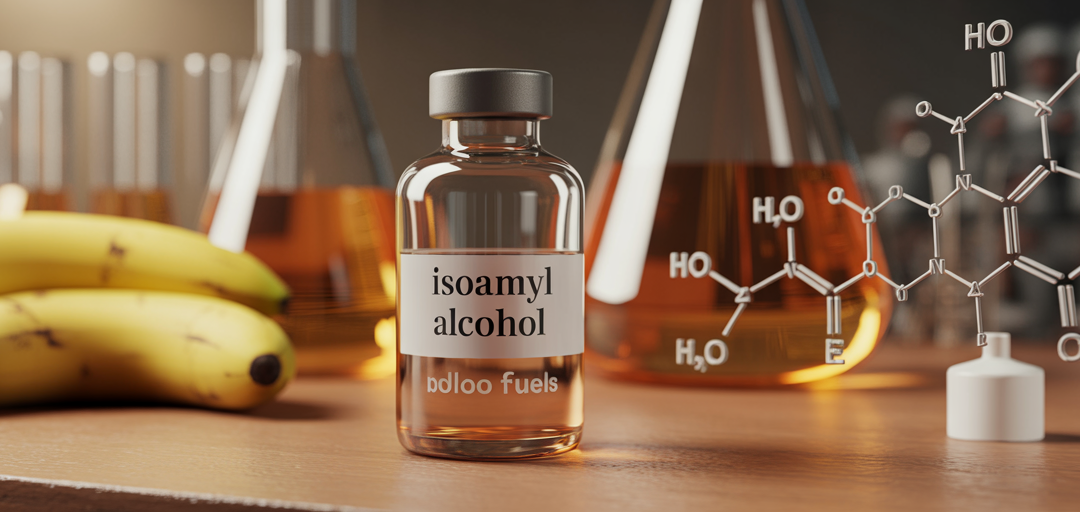
Isoamyl alcohol is a familiar molecule in industry even when its name is not. Also known as 3-methyl-1-butanol or isopentyl alcohol, it is a higher alcohol found naturally in fermentation streams and widely used as a solvent, intermediate and flavour or fragrance building block. Its commercial appeal comes from a combination of practical chemistry and broad end-use relevance: it can dissolve resins and oils, contribute to flavour and fragrance manufacture, support pharmaceutical and laboratory chemistry, and act as a feedstock for esters such as isoamyl acetate, the compound commonly associated with banana aroma.
That makes it a useful case study in how small speciality molecules create value across multiple sectors. Isoamyl alcohol is not a glamour chemical, but it touches food flavouring, perfumery, coatings, process solvents, pharma intermediates and emerging bio-based fuel discussions. It also sits close to the ethanol industry because one major commercial route starts with fusel oil, a by-product of alcohol fermentation and distillation. That link to fermentation has helped keep interest alive in bio-based supply and circular process design.
The headline market claim often attached to isoamyl alcohol needs caution, however. The suggestion that isoamyl alcohol alone is already a USD 47–50 billion market is not supported by the current public source base. Public market reports located for isoamyl alcohol itself generally place the market in the low hundreds of millions of US dollars rather than tens of billions. Published estimates vary, but they cluster much closer to roughly USD 120 million to USD 270 million over the next several years, depending on source, scope and forecast horizon. A “USD 50 billion” figure is more likely to refer to a broader flavour, fragrance, solvents or speciality chemicals category rather than to neat isoamyl alcohol as a single product.
That does not weaken the business case. It sharpens it. Isoamyl alcohol matters not because it is a giant stand-alone market, but because it is a versatile intermediate and solvent embedded in much larger downstream industries. Its importance lies in what it enables.
Chemistry and core properties
Isoamyl alcohol is a five-carbon branched primary alcohol with the molecular formula C5H12O. Commercially, the term often refers mainly to 3-methyl-1-butanol, although industrial material can include closely related amyl alcohol isomers depending on source and grade. It is a colourless liquid with a characteristic alcoholic, fermented odour, and it is best known in flavour chemistry as the precursor to isoamyl acetate.
From a formulation perspective, its property profile is straightforward but commercially useful. It has moderate polarity, making it a capable solvent for oils, waxes, resins and certain organic compounds. It remains liquid across a very wide temperature range, has a boiling point high enough for controlled process use, and shows limited but meaningful water solubility. Those features explain why it appears in solvent systems, synthesis routes and aroma chemistry rather than being confined to a single niche.
Core property snapshot
| Property | Isoamyl Alcohol |
|---|---|
| Chemical formula | C5H12O |
| CAS number | 123-51-3 |
| Common chemical name | 3-methyl-1-butanol |
| Physical form | Colourless liquid |
| Typical boiling point | about 131°C |
| Typical density at 20°C | about 0.81 g/cm³ |
| Flash point | about 43–44°C |
| Water solubility | limited, but not negligible |
Its sensory character is also commercially important. On its own, isoamyl alcohol has a fusel, fermented, whisky-like odour profile rather than a clean fruit note. The “banana” association comes mainly from its ester, isoamyl acetate, not from the alcohol itself. That distinction matters for marketers and formulators because isoamyl alcohol is often positioned through the downstream aroma chemistry it enables rather than through its own direct odour value.
Production routes and manufacturing overview
Isoamyl alcohol comes from two broad production logics: separation from fermentation-derived fusel oil, and synthetic or catalytic routes built around petrochemical feedstocks or engineered bioprocesses.
The established industrial route is closely linked to ethanol production. Fusel oil, a by-product of fermentation and distillation, contains a mixture of higher alcohols, of which isoamyl alcohol is often the major component. That gives producers a circularity advantage: a relatively low-value by-product stream can be upgraded into a saleable chemical intermediate. Recent process research continues to focus on more efficient ways to separate isoamyl alcohol from fusel oil, including advanced distillation and hybrid separation methods. That is commercially relevant because separation cost and purity control directly affect competitiveness in flavour, fragrance and speciality solvent markets.
The second route is direct synthetic or bio-based production. Academic and industrial research has continued to examine microbial production of 3-methyl-1-butanol via engineered metabolic pathways. This is not yet a dominant industrial model, but it matters because it points towards renewable isoamyl alcohol that is decoupled from conventional fusel-oil availability. If fermentation-based chemicals and advanced biofuels continue to expand, engineered production could become more attractive.
Manufacturing route comparison
| Route | Feedstock | Commercial status | Main strength | Main limitation |
|---|---|---|---|---|
| Fusel oil separation | Fermentation by-product | Established | Circular feedstock use, existing industrial base | Separation cost and variable composition |
| Synthetic petrochemical route | Petrochemical intermediates | Established / selective use | Consistent output and controllable specifications | Less favourable renewable positioning |
| Engineered microbial route | Sugars and biomass-derived carbon | Emerging | Renewable platform potential | Scale-up economics still developing |
The commercial takeaway is that isoamyl alcohol benefits from an unusual position: it can be both a classic petrochemical-style solvent and a bio-based upgrading opportunity. That dual identity should keep it relevant as buyers ask harder questions about feedstock origin and process sustainability.
Current market uses and industry applications
Isoamyl alcohol’s end-use profile is broad, but several application clusters stand out.
In flavours and fragrances, it is less often the hero ingredient than the precursor. Its largest sensory importance comes through esterification, especially to produce isoamyl acetate. This ester is widely used in fruit flavour systems, fragrance accords and speciality aroma blends. Suppliers explicitly market isoamyl alcohol as a raw material for synthetic fruit flavours and “banana oil”, reinforcing the point that its value often sits one step downstream.
In food applications, isoamyl alcohol is recognised in the United States under the framework for synthetic flavouring substances and adjuvants when used in accordance with good manufacturing practice. FEMA and FDA listings support its role as a flavouring substance. That does not mean it is used at large volume in food on its own, but it confirms regulatory acceptance in controlled flavour use.
In fragrances and cosmetics, isoamyl alcohol is not a prestige perfume note in itself, yet it remains relevant as a solvent and intermediate. It supports the manufacture of fragrance ingredients and can appear in speciality personal care and aroma ingredient systems. Claims that “millennial-led cosmetic demand” is directly driving isoamyl alcohol demand should be treated carefully. The more defensible position is that growth in personal care and fine fragrance can support certain downstream aroma chemicals derived from it, rather than causing a direct surge in neat isoamyl alcohol consumption.
In coatings and industrial formulations, isoamyl alcohol functions as a speciality solvent and intermediate. Its solvency profile makes it useful in selected resin, oil and formulation systems where volatility, solvency strength and process behaviour need balancing. This is not the largest public-facing market, but it is one of the reasons isoamyl alcohol maintains cross-sector relevance.
Pharmaceutical and laboratory chemistry provide another outlet. Isoamyl alcohol is routinely sold as a synthesis solvent and laboratory reagent, and it appears in extraction systems and intermediate chemistry. Its pharmaceutical role is generally indirect, tied more to synthesis and process use than to active ingredient status.
Sector view of commercial demand
| Sector | How isoamyl alcohol is used | Commercial importance |
|---|---|---|
| Flavours | Precursor to fruit-flavour esters, especially isoamyl acetate | High value, specification-driven |
| Fragrances | Intermediate and solvent for aroma chemistry | Steady speciality demand |
| Food | Permitted flavouring substance under controlled use | Low-volume, regulated niche |
| Coatings and resins | Specialty solvent and formulation aid | Practical industrial outlet |
| Pharma and labs | Solvent, reagent and process intermediate | Stable, grade-sensitive demand |
| Bio-based chemicals | Feedstock and platform chemical | Emerging opportunity |
This spread of uses explains why isoamyl alcohol does not need one spectacular growth story to remain commercially useful. It already serves multiple value chains with different demand cycles.
Sensory chemistry and formulation value
The sensory story around isoamyl alcohol is often oversimplified. It is widely associated with banana notes, but that shorthand really belongs to isoamyl acetate. The alcohol itself has a more fermented, fusel, spirit-like profile. That distinction matters for formulators because it shapes how the material is handled commercially.
In flavour work, isoamyl alcohol is valued because it can be transformed into cleaner, more recognisable fruit notes through esterification. In fragrance work, it behaves more as a building block or process ingredient than as a front-of-pack aroma hero. This is a classic example of upstream sensory chemistry: the commercial value sits not mainly in the starting material’s odour, but in the derivative molecules it enables.
That has a practical formulation consequence. Buyers may not prioritise isoamyl alcohol because consumers ask for it by name. They prioritise it because it is an efficient route to desirable flavour and fragrance outcomes.
Emerging and future growth areas
The most credible growth area is bio-based production and upgrading from fusel oil. Recent reviews and process studies continue to highlight fusel oil as a renewable industrial input, not merely a waste stream. Because isoamyl alcohol is often the dominant component of fusel oil, the economics of separation and upgrading remain attractive wherever ethanol production is already established.
A second growth area is renewable fuels and fuel blends. Here the opportunity is real, but it should not be overstated. Isoamyl alcohol has drawn research interest as an advanced biofuel candidate and as part of higher-alcohol fuel discussions because it has better energy density and blending characteristics than ethanol in some contexts. However, the nearer-term commercial story is still more about research, pilot evaluation and niche blending than about mass-market displacement of conventional fuels.
A third area is derivative chemistry. Isoamyl acetate remains the obvious example, but broader ester and speciality chemical pathways also benefit from reliable isoamyl alcohol supply. As circular chemistry and by-product valorisation gain attention, companies may increasingly see isoamyl alcohol not only as a product, but as a flexible C5 building block.
Indicative demand and innovation map
Industrial solvents | ██████
Pharma / lab use | █████
Bio-based chemical feedstock | ███████
Fuel and blendstock potential | ████
This is not a quantitative forecast, but it reflects the present balance of the market: established value in flavour and solvent uses, with bio-based chemical and fuel interest adding strategic optionality.
Comparison with related alcohols and solvents
Isoamyl alcohol sits alongside other higher alcohols such as isobutanol, n-amyl alcohol and 2-ethylhexanol, but it occupies a distinct commercial position.
Compared with ethanol, it is less universal but more specialised. Ethanol dominates where low cost, broad familiarity and regulatory acceptance matter. Isoamyl alcohol is chosen where different solvency, lower volatility or downstream ester chemistry are more important.
Compared with isobutanol, isoamyl alcohol tends to have a stronger association with flavour and fragrance intermediates and a somewhat narrower but more distinctive speciality-chemicals role. Isobutanol has attracted wider attention as a transport-fuel candidate and solvent platform, while isoamyl alcohol remains more tightly linked to aroma chemistry and fusel-oil upgrading.
Compared with n-amyl alcohol, isoamyl alcohol benefits from stronger identity in flavour and fragrance chemistry, particularly because of the established value chain into isoamyl acetate.
Comparison table
| Chemical | Main strength | Typical limitation | Best-fit uses |
|---|---|---|---|
| Isoamyl alcohol | Versatile intermediate for esters and speciality solvents | Smaller market than broader commodity alcohols | Flavours, fragrances, solvent systems, bio-based upgrading |
| Ethanol | Low cost, familiar, broad regulatory acceptance | Lower energy density and different solvency profile | Beverages, disinfectants, broad solvent uses, fuel |
| Isobutanol | Attractive fuel and solvent profile | Less direct association with flavour chemistry | Coatings, solvents, fuel blends |
| n-Amyl alcohol | Useful solvent and intermediate | Lower sensory-market profile | Solvents, selected chemical synthesis |
Challenges, constraints and regulatory considerations
Isoamyl alcohol is commercially useful, but it is not frictionless.
The first issue is flammability and workplace handling. Safety data indicate a flash point around the low-to-mid 40s °C, meaning standard solvent-handling controls are necessary. It is also an irritant and must be managed with appropriate ventilation, storage and PPE. This is routine for industrial solvents, but it still matters for logistics and customer qualification.
The second issue is regulatory fit by application. In food and flavour use, the material has a recognised place under US flavouring regulations when used correctly and at the minimum required level. That is positive, but it does not remove the need for formulation-specific compliance in finished products. In Europe, substance identity and registration information are established through ECHA systems, which supports industrial traceability but still requires customers to match the substance to their own regulatory obligations.
The third issue is feedstock variability when the source is fusel oil. Bio-based positioning sounds attractive, but fusel oil composition can vary according to fermentation feedstock, yeast behaviour and distillation conditions. That means producers must invest in separation and purification if they want dependable flavour, fragrance or pharmaceutical grades.
The fourth issue is market scale realism. Because the stand-alone market is modest compared with bulk solvents, volume growth can be constrained by niche application economics. That is not a weakness so much as a structural feature of speciality chemicals. Value growth depends on application quality and downstream relevance more than on sheer tonnage.
Practical sourcing and formulation considerations
For buyers, grade selection is central. Food, flavour and fragrance users will care about purity, odour consistency and trace impurity profile. Industrial solvent buyers may prioritise assay and supply reliability. Laboratory and pharma-related users will focus more heavily on documentation, batch reproducibility and impurity control.
Supply-chain origin also matters more than it might first appear. A petrochemical route may offer consistency and scale, while a fusel-oil route may offer a stronger renewable narrative. Neither is automatically better. The better choice depends on application, customer claims, cost tolerance and audit requirements.
Formulators should also keep the derivative logic in mind. In some cases the better commercial decision is not to buy isoamyl alcohol as a direct ingredient, but to evaluate whether the downstream ester or derivative is the true performance driver. That seems obvious, but it is often where margin and specification discipline are actually created.
Conclusion
Isoamyl alcohol is a good example of a molecule whose relevance exceeds its headline market size. It is not a USD 50 billion chemical in its own right, at least not on the basis of current public evidence. But it is a strategically useful speciality alcohol with real importance in flavours, fragrances, solvents, laboratory chemistry and the bio-based chemicals conversation.
Its strongest commercial position lies in three areas. First, it is a reliable building block for flavour and fragrance derivatives, especially isoamyl acetate. Second, it is a practical speciality solvent with steady industrial uses. Third, it has a credible role in circular chemistry because it can be recovered from fusel oil and potentially expanded through renewable bioprocesses.
The future growth story is therefore not about hype. It is about intelligent positioning. Companies that treat isoamyl alcohol as a versatile C5 platform molecule, rather than as a narrow commodity solvent, are likely to get the most value from it.