
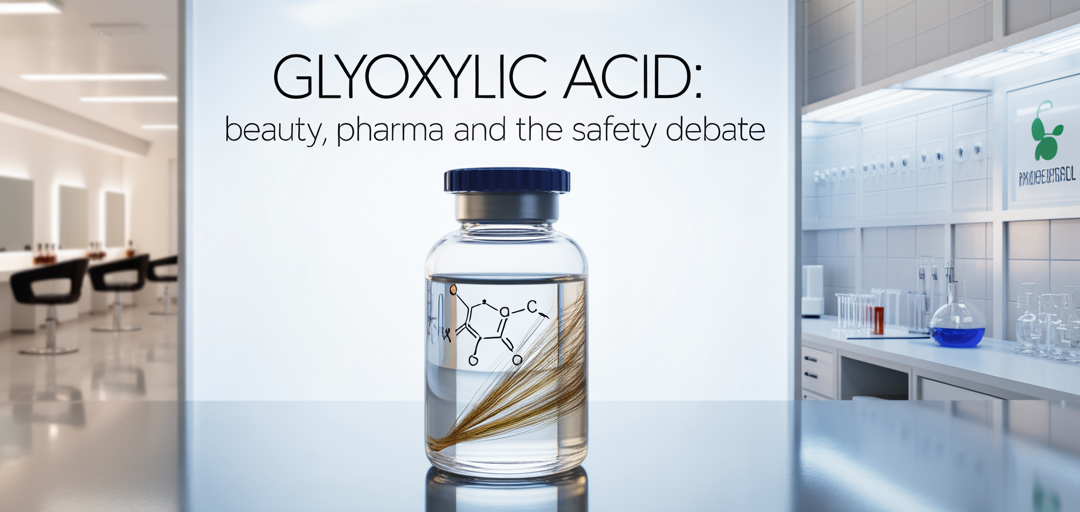
Glyoxylic acid is not a household chemical, but it sits inside several large and commercially important value chains. It is used as an intermediate in pharmaceuticals, flavours and fragrances, agrochemicals and specialty chemicals, and in recent years it has gained much wider visibility through hair-smoothing and straightening products. That combination of industrial relevance and consumer-facing controversy makes it unusually timely.
At a chemistry level, glyoxylic acid is a bifunctional molecule: it contains both an aldehyde group and a carboxylic acid group. That makes it highly reactive and commercially versatile. It can be used to build more complex molecules, which is why it appears in the synthesis of pharmaceutical intermediates, vanillin derivatives, allantoin and a range of fine chemicals. PubChem lists it broadly as an intermediate for flavourings, perfumes, pharmaceuticals, dyes, plastics and agricultural chemicals.
The business story is attractive, but it is not as simple as some market headlines suggest. Public market summaries commonly place the glyoxylic acid market in the few-hundred-million-dollar range and project steady expansion through the early 2030s. The user-supplied framing of roughly USD 350 million growing towards USD 620 million by 2032 is plausible as an indicative range, but public forecasts vary, so it is better treated as directional than definitive. What is clearer is the mix shift within demand: cosmetics, especially hair smoothing, have raised visibility, while pharmaceuticals and fine chemicals remain the steadier long-term industrial base.
That would already be enough for a useful industry article. What changes the tone is safety scrutiny. In 2025, the European Commission launched a formal call for data on glyoxylic acid in hair-straightening products after French authorities raised concerns about renal toxicity. ANSES stated that glyoxylic acid in these products can cause acute kidney failure and recommended avoiding their use pending regulatory measures. That puts glyoxylic acid in a commercially important but more contested position than many intermediates of similar size.
Chemistry and core properties
Glyoxylic acid, sometimes called oxoacetic acid, is one of the simplest aldehyde acids. Its dual functionality is what gives it industrial value. The aldehyde portion participates readily in condensation and derivatisation chemistry, while the carboxylic acid portion supports salt formation, esterification and downstream synthesis routes.
In practice, glyoxylic acid is often handled in aqueous solution or as a monohydrate rather than as an idealised neat compound. Industrial users care less about textbook structure than about concentration, stability, impurity profile and suitability for a given synthesis route. That is particularly true in pharmaceutical and cosmetic applications, where specification discipline is more important than nominal assay alone.
Core property snapshot
| Property | Glyoxylic Acid |
|---|---|
| Chemical formula | C₂H₂O₃ |
| Main functional groups | Aldehyde and carboxylic acid |
| Typical commercial form | Aqueous solution / monohydrate |
| Key commercial role | Intermediate for synthesis and formulation |
| Main end-use sectors | Cosmetics, pharmaceuticals, flavours, agrochemicals |
The molecule’s commercial strength is that it is both reactive and adaptable. That makes it useful in relatively high-value chemistry. The trade-off is that highly reactive intermediates tend to demand closer control in manufacturing, handling and application. Glyoxylic acid is therefore not simply a bulk organic acid. It is a speciality intermediate whose value depends heavily on grade, downstream chemistry and regulatory context.
Production routes and manufacturing overview
The conventional industrial route starts from glyoxal. Glyoxal is oxidised to glyoxylic acid, historically using nitric acid. This route is well established and remains the reference point in much of the technical literature. However, it carries a clear environmental drawback: nitric-acid oxidation generates nitrogen oxides, which adds cost and process burden to emissions control. Older patents and process papers describe the route as industrially practical but environmentally imperfect.
That matters because glyoxylic acid is a useful case study in how mature chemical processes come under renewed scrutiny. The industry already knows how to make the molecule at scale. The current question is whether it can be produced more cleanly and with better atom efficiency.
Alternative approaches have therefore attracted attention. Catalytic oxidation methods and bio-based or enzymatic routes have been studied as lower-impact options. For example, patent literature describes enzymatic oxidation of glycolic acid using glycolate oxidase, while research has examined catalytic approaches designed to avoid some of the disadvantages of stoichiometric nitric-acid oxidation. These are commercially relevant because buyers increasingly look beyond price and ask about emissions intensity, feedstock logic and process sustainability.
Production route comparison
| Route | Feedstock | Commercial status | Main advantage | Main limitation |
|---|---|---|---|---|
| Nitric-acid oxidation of glyoxal | Glyoxal | Established | Mature industrial process | NOx generation and environmental burden |
| Catalytic oxidation approaches | Glyoxal / related substrates | Developing | Potentially cleaner chemistry | Process optimisation still important |
| Enzymatic oxidation of glycolic acid | Glycolic acid | Early-stage / specialist | Lower-temperature, greener pathway potential | Industrial scale economics less proven |
For procurement teams, the immediate point is not that green glyoxylic acid is already standard. It is not. The point is that production-route visibility is becoming more commercially relevant, especially where personal care, regulated intermediates or sustainability-led buyers are involved.
Current market uses and industry applications
The headline hook around glyoxylic acid often focuses on hair care, but that is only one part of the story.
In cosmetics, glyoxylic acid has become prominent in hair-smoothing and straightening products marketed as alternatives to older formaldehyde-linked treatments. The chemistry is attractive because glyoxylic acid can modify hair fibre behaviour under heat, producing a semi-permanent smoothing effect. This is why it has spread through salon and at-home formulations. The European Commission’s CosIng database explicitly lists glyoxylic acid with a hair waving or straightening function, confirming its recognised cosmetic role.
In pharmaceuticals and fine chemicals, the role is less visible but often more durable. Glyoxylic acid is used as an intermediate in making compounds linked to antibiotics, antihypertensives, amino acid derivatives and other medicinal chemistry pathways. Official EU trade-regulation text published in 2025 explicitly described glyoxylic acid as an intermediate product used to produce antibiotics, vanillin and allantoin. Commercial chemical suppliers likewise describe it as a synthetic intermediate for compounds such as ampicillin and atenolol. Supplier descriptions should be treated carefully, but in this case they align with the broader industrial picture: glyoxylic acid is a recognised pharmaceutical building block.
Flavours and fragrances are another important outlet. Glyoxylic acid is a known intermediate in vanillin manufacture, which gives it relevance beyond the laboratory and into food, fragrance and aroma chemistry. It also appears in allantoin production, linking it to cosmetics and dermatological formulations through another route.
Agrochemicals, dyes, plastics and related specialty chemicals round out the demand base. PubChem’s use profile is broad here, and that breadth matters commercially because it reduces reliance on any one end market.
Major application areas
| End market | How glyoxylic acid is used | Commercial significance |
|---|---|---|
| Hair care / cosmetics | Hair smoothing and straightening agent | High visibility, fastest scrutiny |
| Pharmaceuticals | Intermediate for APIs and medicinal chemistry | High value, specification-driven |
| Flavours and fragrances | Intermediate in vanillin pathways | Stable specialty demand |
| Allantoin and personal care intermediates | Upstream synthesis building block | Supports cosmetic and dermatology chains |
| Agrochemicals and specialty chemicals | Intermediate for formulations and derivatives | Diversifies demand base |
Emerging and future growth areas
The first likely growth area remains personal care, but with qualifications. Hair-smoothing products helped move glyoxylic acid into a wider commercial spotlight. That demand can still grow, but it is now exposed to toxicology findings, regulatory intervention and potential reformulation pressure. Growth, in other words, may continue in the near term, but it is no longer an uncomplicated opportunity.
The second growth area is pharmaceutical and fine chemical synthesis. This is less visible to consumers, but often more resilient. Molecules that function as intermediates in multiple synthesis routes tend to keep a place in the market even when one application becomes contested. Glyoxylic acid’s utility in antibiotics, amino-acid chemistry, allantoin production and vanillin-related synthesis supports that steadier outlook.
The third area is process innovation. If cleaner oxidation or biocatalytic routes become more economic, they could improve the position of glyoxylic acid with buyers who care about emissions and greener sourcing. That will not transform the market overnight, but it does create scope for differentiation.
Indicative growth momentum by application
Flavours / vanillin | █████
Allantoin / personal care | ██████
Hair smoothing products | ████████
Agrochemicals / specialties | █████
Regulatory risk factor | █████████
The chart above is a commercial simplification rather than a quantitative forecast, but it captures the market tension well: the same application area driving visibility is also the one attracting the most scrutiny.
Comparison with related chemicals
Glyoxylic acid is sometimes compared loosely with other alpha-oxo or hydroxy acids used in cosmetics and synthesis, but those comparisons can be misleading. Glycolic acid, for example, is better known in skin care as an exfoliating alpha-hydroxy acid. Glyoxylic acid is chemically different and commercially broader as a synthetic intermediate.
Within hair care, the more relevant comparison is not with exfoliating acids but with older straightening chemistries involving formaldehyde or formaldehyde-releasing systems. Glyoxylic acid gained traction partly because it was marketed as a different option. However, regulatory interest has increased because concerns now focus not only on formaldehyde release under certain conditions, but also on direct renal toxicity associated with heated use in hair-straightening products. That makes glyoxylic acid less of a simple “safer replacement” story than some earlier marketing implied.
Challenges, constraints, safety and regulatory considerations
This is now the defining commercial issue for glyoxylic acid.
In January 2025, ANSES concluded that the available evidence confirmed the risk of acute kidney injury from glyoxylic acid in hair-straightening products. The agency stated plainly that glyoxylic acid can cause acute kidney failure in this context and recommended restricting or even banning its use in such products. It also advised consumers and professionals to avoid hair-straightening products containing the substance pending regulatory measures. That is a serious intervention, not a routine precautionary note.
The European Commission then opened a call for data in April 2025 to support safety assessment of glyoxylic acid in cosmetic products, specifically citing the ANSES concerns and the lack of an SCCS assessment for this use. Meeting records from 2025 show the issue being taken forward in the SCCS context. This means the regulatory process is active rather than speculative.
That has several implications.
For cosmetic brands, the risk is not only toxicological but commercial. Products positioned as salon-safe or formaldehyde-free may now need reformulation, relabelling or tighter professional controls. For distributors, there is inventory and compliance exposure if rules tighten. For ingredient suppliers, the growth opportunity in hair care may narrow even if overall glyoxylic acid demand remains intact elsewhere.
More broadly, recent EU trade action also highlights glyoxylic acid’s industrial importance. A 2025 Commission implementing regulation concerning imports from China identified glyoxylic acid as an intermediate used to produce antibiotics, vanillin, allantoin, cosmetics and fragrances. That is not a safety measure, but it does underline how strategically the material is viewed in European downstream industries.
Practical sourcing and formulation considerations
For industrial buyers, glyoxylic acid should be treated as a grade-sensitive intermediate. Pharmaceutical and fine-chemical applications require consistency, impurity control and reliable supply documentation. Cosmetic use adds another layer: toxicology, legal exposure and region-specific regulatory watchfulness.
Three procurement considerations stand out.
First, end-use fit matters more than nominal purity. A material acceptable for general chemical synthesis may not be appropriate for personal care or tightly controlled pharmaceutical routes.
Second, route transparency is gaining importance. Conventional glyoxal oxidation remains common, but buyers with sustainability targets may increasingly ask how the product was made and what by-products or emissions controls are involved.
Third, regulatory horizon scanning is now essential for cosmetic applications. A sourcing decision that ignores the live EU scrutiny around hair straightening could become expensive quickly.
Buying priorities by sector
| Sector | Main buying priority | Main commercial risk |
|---|---|---|
| Cosmetics / hair care | Safety dossier, compliant use profile | Regulatory restriction or reformulation |
| Pharmaceuticals | Consistent impurity profile, documentation | Batch failure or qualification delays |
| Flavours / vanillin | Reliable intermediate supply | Feedstock volatility |
| Specialty chemicals | Cost-performance balance | Variable downstream demand |
Conclusion
Glyoxylic acid has earned its place as a commercially useful intermediate because it bridges multiple industries. It matters in hair care, but it also matters in pharmaceutical synthesis, vanillin production, allantoin manufacture and other specialty chemical routes. That is what gives it real industrial weight.
The current market narrative, however, is shaped by tension rather than by straightforward growth. On one side, glyoxylic acid benefits from diversified industrial demand and a plausible medium-term expansion path from a few hundred million dollars towards a larger speciality market by the early 2030s. On the other, its visibility in hair-smoothing products has triggered significant health and regulatory scrutiny, especially in Europe.
For business audiences, that makes glyoxylic acid more interesting, not less. It is no longer just another intermediate. It is a case where chemistry, consumer trends, toxicology and regulation are colliding in real time. The most durable commercial opportunities are therefore likely to sit in pharmaceutical and fine-chemical uses, cleaner production routes and carefully controlled formulation strategies rather than in aggressive consumer-beauty positioning alone.