
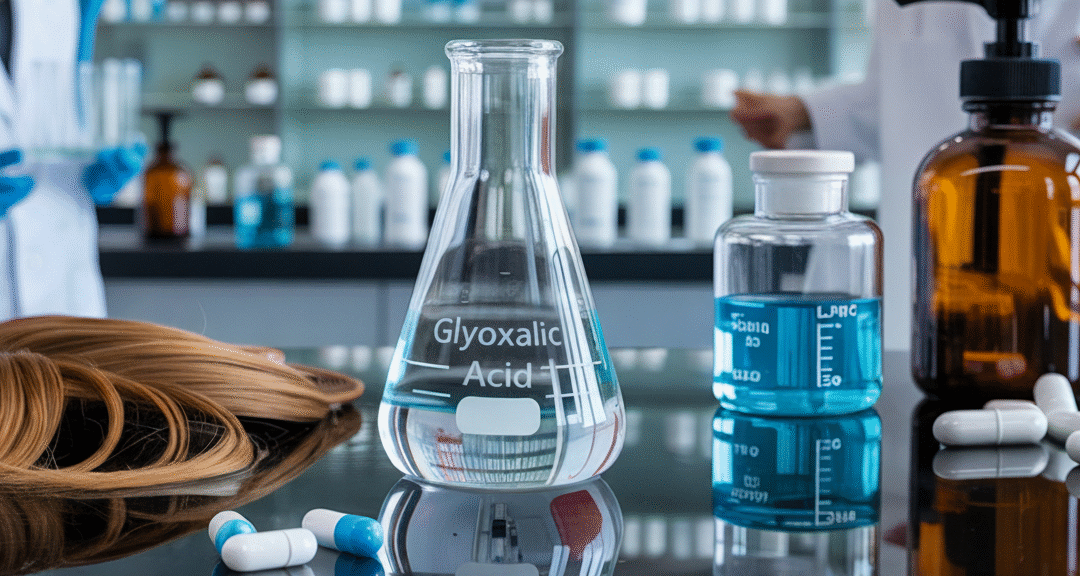
Glyoxylic acid sits at an unusual crossroads. It’s the quiet aldehydic acid behind glossy “formaldehyde-free” hair-smoothing services, a linchpin intermediate for blockbuster pharmaceuticals such as amoxicillin and atenolol, a feedstock to flavours like vanillin, and a workhorse in agrochemicals and water-treatment chemistry. That versatility is now matched by scale: credible trackers place the global market in the $350–380 million range in the mid-2020s with trajectories toward ~$620 million by 2032—even as regulators scrutinise salon exposures and toxicologists investigate renal safety signals from cosmetic use. This piece cuts through the hype to map what glyoxylic acid is, how it’s made, where it delivers value, what the real safety and regulatory issues are, and how buyers can specify and source it responsibly for the decade ahead.
Glyoxylic Acid 101: A small molecule with outsize influence
Chemically, glyoxylic acid (CAS 298-12-4; oxoethanoic acid) is the two-carbon cousin of acetic acid bearing an aldehyde in place of a methyl group. That duality—carboxylic acid + aldehyde—is why it behaves like a reactive building block in condensation chemistry (phenols, amines) yet still shows the solubility and handling profile of small organic acids. In water it partially exists as the conjugate base (glyoxylate), and at neutral pH it can engage in transamination and aldol-type pathways that underpin several industrial syntheses.
Industrial production routes. Modern plants typically produce glyoxylic acid by oxidising glyoxal with nitric acid (with careful heat management and selectivity controls), sometimes in continuous-flow microreactors that enhance safety and yield. Alternative textbook routes—ozonolysis of maleic acid or electrosynthetic methods—are more niche but emphasize the molecule’s platform nature across petro- and potentially bio-sourced streams.
Why it matters. That aldehydic carbonyl bonds efficiently to phenols and amines, enabling the phenol → 4-hydroxymandelic acid → hydroxyphenylglycine sequence (a precursor to amoxicillin), and reduction to 4-hydroxyphenylacetic acid (on the atenolol route). With substituted phenols like guaiacol, the condensation/oxidation/decarboxylation cascade gives vanillin/ethyl vanillin—longstanding pillars of the flavours market.
Market size and momentum: reconciling the numbers
Market estimates diverge because methodologies differ (value vs volume, monohydrate vs anhydrous, merchant vs captive use, cosmetic share, and regional coverage). Still, the shape is consistent: modest mid-single- to high-single-digit growth, led by cosmetics/personal care and pharma intermediates, with Asia-Pacific as both the largest producer and consumer.
Table 1 — Glyoxylic acid market snapshots (illustrative comparison)
| Source (year) | Base value | Forecast horizon | Forecast | Implied CAGR | Notes |
|---|---|---|---|---|---|
| SkyQuestt (2025) | $371.6M (2024) | to 2032 | $619.6M | ~6.6% | Closely matches the ~$350M → ~$620M narrative used by operators. |
| DIResearch (2025) | $279.5M (2025) | to 2032 | $396.7M | ~5.1% | Lower scope/value allocation; indicative of methodology spread. (marketresearch.com) |
| Fact.MR (2025) | $652M (2025) | to 2035 | $919M | ~3.5% | Higher base; conservative growth—possibly broader scope. |
| Market Research Future (2025) | $660M (2024) | to 2035 | $1.08B | ~4.6% | Larger baseline; personal care highlighted. |
What to take away. For strategic and procurement planning, treat $350–380M today rising toward ~$600M by early-2030s as a reasonable working range, with grade/purity mix and regional downstream mix (cosmetics vs pharma) as the biggest levers.
A quick visual: where the demand is heading
Global Glyoxylic Acid Market (US$ million, indicative)

2024 | ██████████████████████  ~372
2026 | ██████████████████████████  ~420
2028 | ██████████████████████████████  ~480
2030 | ███████████████████████████████████  ~545
2032 | ████████████████████████████████████████  ~620
Chart is illustrative, scaled to the SkyQuestt base and CAGR; actual trajectories vary by method and region.
Where glyoxylic acid earns its keep (and why)
1) Hair care: “formaldehyde-free” smoothing—with caveats
In salon formulations, glyoxylic acid is used as a keratin crosslinking agent in heat-assisted “Brazilian” or “progressive brush” services positioned as alternatives to formaldehyde releasers. The aldehyde reacts with amino acid side chains in hair fibres; when heat and tension are applied, semi-permanent straightness is achieved. Patents and academic work confirm that low-percent solutions can improve straightness scores under defined thermal profiles.
Safety signals and regulatory attention. Since 2022, multiple case series have described acute kidney injury (AKI) consistent with calcium oxalate nephropathy following exposure to glyoxylic-acid–containing straighteners—likely via dermal absorption with metabolism to oxalate. National agencies have issued warnings, and the European Commission has initiated a call for data to evaluate cosmetic safety in heat-use conditions. While causality at population scale is still being characterised, salon ventilation, exposure control, and strict concentration/pH discipline are now essential risk-management practices.
Practical stance. Cosmetic formulators should treat glyoxylic acid as a restricted-use crosslinker: validate exposure at real salon conditions, monitor pH and heat profiles, specify maximum use concentrations, and include clear technician guidance. Where possible, evaluate non-aldehydic smoothing chemistries to diversify risk.
2) Pharmaceuticals: amoxicillin, atenolol, and beyond
Glyoxylic acid underpins two of the best-documented medicinal routes in commodity-to-care chemistry:
- Amoxicillin: The phenol + glyoxylic acid → 4-hydroxymandelic acid → hydroxyphenylglycine sequence is a canonical route to the aminophenylglycine side chain used in semisynthetic penicillins.
- Atenolol: Reduction of 4-hydroxymandelic acid to 4-hydroxyphenylacetic acid supports the β-blocker supply chain.
Suppliers and peer-reviewed syntheses have documented these links for decades, and they remain critical to global antibiotic and cardiovascular drug availability.
3) Flavours, fragrances & fine chemicals
The glyoxylic acid method to vanillin/ethyl vanillin remains an industrial mainstay (especially in regions where lignin routes are less competitive), often optimised via polymetallic catalysts and tuned to suppress polymeric by-products. (patents.google.com)
4) Agrochemicals and water treatment
As a versatile C₂ building block, glyoxylic acid contributes to herbicide and plant-growth regulator syntheses and to chelating/scale-control chemistries in water treatment. Volume swings here track agricultural cycles and municipal budgets; tightening effluent and discharge rules typically support steady demand.
Grades, specifications, and what buyers actually write into POs
Because glyoxylic acid shows up in cosmetic, pharma-intermediate, and industrial contexts, grades vary. The 50% aqueous monohydrate solution is the common commercial form; anhydrous or higher-assay solutions appear in specialised lines.
Table 2 — Typical commercial grades and specification levers (illustrative)
| Grade | Assay (typical) | Key impurity controls | Where it’s used | Buyer notes |
|---|---|---|---|---|
| Industrial/Technical | 50% solution (±1–2%); higher assay in some streams | Nitric-acid residues (as NOx), glyoxal, oxalic/glycolic acids | Flavours (vanillin), agro intermediates, water treatment | Focus on selectivity fingerprints (HPLC/GC) and corrosion-inhibitor compatibility. (patents.google.com) |
| Cosmetic/Personal care | 20–50% in finished products (formulation dependent) | Metals, nitrosating species, bioburden; tight pH window | Heat-assisted smoothing/“progressive brush” | Validate pH & temperature at point-of-use; ventilate; align with evolving EU safety guidance. (Public Health) |
| Pharma/Reagent | 50% solution; higher-purity variants | Trace metals (ICP-MS), aldehydic by-products, residual glyoxal | Routes to HPG/4-HPAA (amoxicillin/atenolol), specialty reagents | Request lot CoAs with method details (KF for water, titration/HPLC for assay; metals by ICP-MS). |
Specs vary by supplier; always negotiate CoA limits and analytical methods explicitly.
How it is made (and made safer)
Glyoxal → glyoxylic acid via nitric acid oxidation remains the industrial workhorse—highly exothermic and prone to thermal runaway unless precisely controlled. Continuous-flow approaches have emerged to stabilise temperature profiles and raise selectivity to glyoxylic acid over oxalic acid by-product, improving carbon efficiency. Process patents also document catalyst systems for downstream vanillin synthesis from glyoxylic acid–phenol adducts. These trends point toward higher atom-economy and safer per-tonne production while keeping costs under control.
Sustainability prospects. While most capacity is petro-linked (glyoxal from ethylene glycol or acetaldehyde routes), the core C₂ framework means glyoxylic acid could piggyback on bio-based glyoxal or bio-maleic innovations over time. For now, the practical decarbonisation levers sit in heat integration, selectivity control, and waste-nitrogen management at existing plants.
Safety: separating signal from noise
Intrinsic hazards. SDS data classify glyoxylic acid as corrosive with potential for serious eye damage and skin sensitisation; acid burns and respiratory irritation are recognised risks at concentrated use. Storage requires corrosion-resistant materials and prudent segregation.
Cosmetic exposure—what’s new. Since 2022, nephrologists and toxicologists have described AKI with oxalate crystals in patients receiving glyoxylic-acid–based hair straightening. Proposed mechanisms include transcutaneous absorption followed by metabolism to oxalate, with heat and ventilation acting as exposure modifiers. National agencies have issued safety warnings and the EU has begun data calls to evaluate use-conditions and concentration limits. The clinical evidence base—ranging from case reports to multi-centre series—continues to grow and now includes clinical-toxicology service case series and Kidney International correspondences.
Regulatory landscape in motion. While the U.S. focus remains on formaldehyde releasers, European authorities are directly evaluating glyoxylic acid in heated hair products. Outcome scenarios range from use-level restrictions and professional-use only guardrails to ban in specific formats if risk/benefit cannot be managed. Salons and brands should prepare documentation and exposure data accordingly.
Application playbook: getting performance without surprises
Hair-smoothing systems. If you formulate or specify these products:
- Set concentration ceilings and strict pH windows (commonly mildly acidic) consistent with your toxicology assessments.
- Design for ventilation and thermal exposure control at the point of use; include salon-friendly instructions and PPE guidance.
- Monitor adverse events (cosmetovigilance) and be ready to support regulators with measured exposure data.
Pharma intermediates. For amoxicillin/atenolol routes:
- Lock in phenolic condensation purity (e.g., 4-hydroxymandelic acid selectivity) by specifying feedstock impurity ceilings (glyoxal, oxalic acid) and metals (if catalytic steps follow).
- Ensure consistent water content in 50% solutions to protect downstream stoichiometry and reactor heat profiles; insist on validated methods (KF, HPLC/GC).
Vanillin/ethyl vanillin. Optimise condensation/oxidation catalyst systems and track polymeric by-products that can foul separation; specify colour/UV absorbance metrics on crude streams to de-risk crystallisation. (patents.google.com)
Agrochemicals & water. For chelating or oxidation-based uses, build compatibility maps with metals and pH to avoid unintended precipitation or corrosion; confirm supply continuity through agricultural cycles.
Supply chain: where capacity lives and what moves price
Regional shape. Asia-Pacific leads production and consumption, reflecting clustering of flavours capacity, pharma intermediates, and personal-care manufacturing. Tightening cosmetics regulation in the EU can tilt grade mix and create regional price spreads for cosmetic-compliant streams.
Price drivers. Costs track glyoxal, nitric acid, and energy, with premiums for pharma/cosmetic grades driven by purification, QA, and packaging (lined drums, high-integrity closures). Where case reports create risk headlines, expect temporary demand pivots among salon brands, occasionally easing cosmetic-grade premiums until regulatory clarity returns.
What buyers should do next (actionable checklist)
- Be precise on grade. Spell out assay, water, glyoxal/oxalic/glycolic limits, and metals in the PO; require method detail on CoAs (KF titration range, HPLC column, ICP-MS LODs). (Glentham)
- Plan for regulatory change. If your end use is heated hair treatments, build contingency plans (alt chemistries, labelling updates, salon training) to avoid business disruption. (Internal Market and Industry)
- Audit packaging & logistics. Prevent corrosion and contamination with compatible materials and headspace management; verify bioburden for cosmetic streams. (Glentham)
- Map substitution risk. For pharma and flavour lines, dual-source critical steps (e.g., 4-hydroxymandelic acid) to buffer outages; monitor maintenance cycles at upstream glyoxal producers.
- ESG and disclosure. If you publish product footprints, gather energy, NOx, and by-product data from suppliers; continuous-flow nitric oxidation can be a credible improvement story. (sciencedirect.com)
Outlook: steady growth amid sharper guardrails
Glyoxylic acid’s decade ahead is not a simple demand parabola. It’s steady growth—cosmetics and pharma will keep pulling—against a backdrop of sharper safety guardrails. Expect:
- Targeted restrictions or professional-use constraints for heat-assisted hair applications unless exposure can be reliably controlled,
- Incremental process intensification and continuous-flow adoption for safer, cleaner production,
- Procurement polarisation toward higher documentation grades (pharma/cosmetic) and away from generic technical specmanship.
For operators who specify clearly, document safety, and diversify applications, glyoxylic acid remains one of the most economical and versatile C₂ building blocks on the market.
References
- Market size and forecasts. SkyQuestt – market at $371.6M (2024), $619.6M by 2032; DIResearch – $279.5M (2025) to $396.7M (2032); Fact.MR – $652M (2025) to $919M (2035); Market Research Future – $0.66B (2024) to $1.08B (2035). (skyquestt.com)
- Production routes and process safety. Continuous-flow nitric oxidation of glyoxal; classic nitric-acid oxidation patent; ozonolysis/method notes. (sciencedirect.com)
- Cosmetic application & performance. Patent literature on keratin shaping with glyoxylic acid; comparative study of acid vs alkaline straighteners. (patents.google.com)
- Health signals & regulation. Kidney International correspondence on crystalline nephropathy; multi-centre case series (AKI) in nephrology; clinical toxicology service case series; ANSES warning (France); European Commission call for data (2025). (New England Journal of Medicine)