
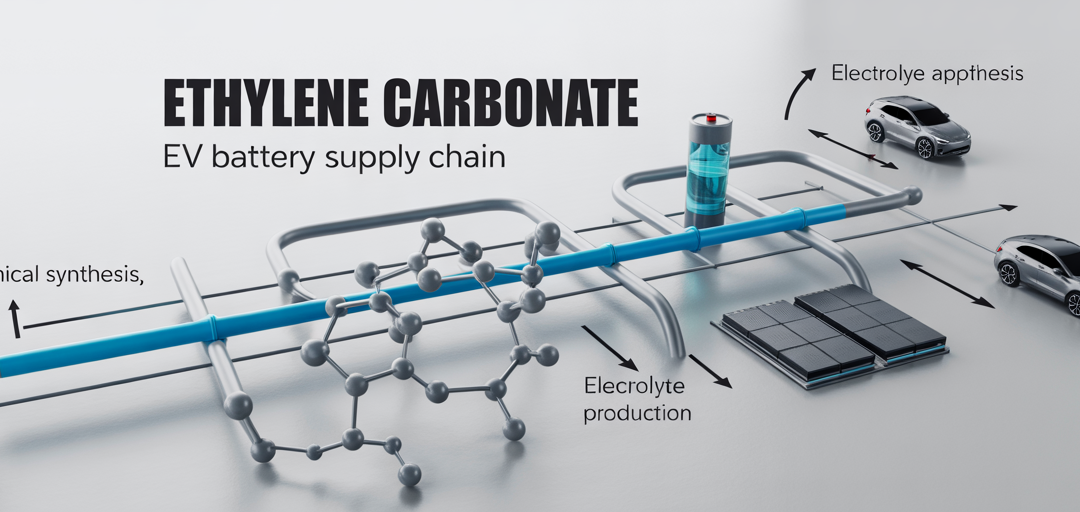
Ethylene carbonate, usually abbreviated to EC, is a small-volume chemical with an outsized role in modern electrification. Chemically, it is a cyclic carbonate ester with the formula C₃H₄O₃. Commercially, it sits at the intersection of petrochemicals, battery materials, specialty solvents and process chemistry. Its importance has risen sharply because EC is one of the core solvents used in lithium-ion battery electrolytes, particularly in systems built around graphite anodes. In practical terms, that makes it relevant to electric vehicles, stationary energy storage, portable electronics and parts of the wider battery materials supply chain.
The timing matters. Battery deployment has moved from a growth story to an industrial scale-up story. The International Energy Agency reported that annual battery demand passed 1 TWh in 2024, while global battery manufacturing capacity reached more than 3 TWh. China remains dominant, holding about 85% of global manufacturing capacity in 2024, but investment is broadening into the United States, the European Union, India, Indonesia and other emerging manufacturing locations. That creates a direct pull-through effect for electrolyte solvents such as EC.
At the same time, the EC narrative is becoming more nuanced. For more than three decades, it has been a standard component of lithium-ion electrolytes because it helps create a stable solid electrolyte interphase, or SEI, on graphite. Yet newer battery designs are exposing its limitations in fast charging, low-temperature operation and high-voltage stability. So the market is being pushed in two directions at once: more total demand from battery growth, and more formulation pressure from next-generation cell performance requirements.
That tension is why EC deserves attention now. It is not merely another carbonate solvent. It is both a beneficiary of the EV boom and a chemical whose long-term position will depend on how electrolyte science evolves.
Chemistry and core properties
Ethylene carbonate is a highly polar cyclic carbonate. At room temperature it is typically a low-melting crystalline solid, becoming liquid just above ambient conditions. That physical behaviour is commercially important because EC is rarely used alone in lithium-ion electrolytes. Instead, it is usually blended with lower-viscosity linear carbonates such as dimethyl carbonate, ethyl methyl carbonate or diethyl carbonate to produce a workable electrolyte.
Its enduring value comes from a combination of properties. EC has a high dielectric constant, which helps dissolve lithium salts effectively. That supports ionic conductivity once the solvent is mixed with lower-viscosity co-solvents. It is also strongly associated with the formation of the SEI layer on graphite anodes during initial cell cycling. A robust SEI is essential because it protects the anode surface while still allowing lithium-ion transport. Without that passivating layer, cycle life and safety deteriorate quickly.
The drawback is that the same features that make EC useful also create constraints. It has a relatively high melting point compared with many other carbonate solvents, which hurts cold-weather performance. Its strong solvation behaviour can slow lithium desolvation at the electrode interface, which is one reason it is increasingly scrutinised in fast-charging applications. Research published in 2024, 2025 and 2026 has reinforced this trade-off: EC remains highly functional for graphite passivation, but it can become a bottleneck when battery developers target wider temperature windows, higher voltages and shorter charging times.
Core property snapshot
| Property | Ethylene Carbonate |
|---|---|
| Chemical formula | C₃H₄O₃ |
| CAS number | 96-49-1 |
| Physical form at 25°C | Low-melting solid / crystalline |
| Typical melting point | 35–38°C |
| Typical boiling point | 243–244°C |
| Density at 25°C | about 1.32 g/mL |
| Role in batteries | High-permittivity solvent and SEI-forming component |
| Commercial grades | Industrial, synthesis, battery grade |
For procurement and formulation teams, purity is a practical issue rather than a detail. Battery-grade EC is sold with tightly controlled moisture and acid content, often below 10 ppm each. Those limits are significant because water and acidic impurities can degrade lithium salts such as LiPF₆ and reduce electrolyte stability. In battery manufacture, impurity management is not an optional upgrade; it is part of the performance specification.
Production routes and manufacturing overview
Industrial EC is most commonly made by reacting ethylene oxide with carbon dioxide. This route is attractive because it is atom-economical, well understood and already embedded in industrial cyclic carbonate chemistry. It also uses CO₂ as a feedstock, which sounds inherently favourable from a sustainability perspective. In reality, the environmental profile depends on the origin of the ethylene oxide, the source of the carbon dioxide, the energy intensity of the process and the efficiency of purification.
The conventional process remains commercially dominant because it is proven, scalable and compatible with existing petrochemical infrastructure. Catalysts vary, but the chemistry is mature enough that the industrial conversation is less about whether EC can be made efficiently and more about whether it can be made with lower emissions, lower energy intensity and better integration with carbon management strategies.
Alternative and emerging routes are gathering interest for exactly that reason. One route uses ethylene glycol and urea to form EC, often under reduced pressure and in the presence of solid catalysts. This chemistry has been studied for years and continues to attract attention because it can fit broader carbon-utilisation and process-integration strategies. A more recent development is electrochemical synthesis from ethylene and CO₂, which points to a longer-term possibility of coupling EC production to cleaner electricity and lower-carbon feedstocks. That remains an emerging route rather than a near-term industrial replacement, but it signals where process innovation is heading.
Manufacturing route comparison
| Route | Feedstocks | Commercial status | Main advantage | Main limitation |
|---|---|---|---|---|
| CO₂ + ethylene oxide cycloaddition | Ethylene oxide, carbon dioxide | Established | High selectivity, mature scale-up | Depends on fossil-based EO in most supply chains |
| Urea + ethylene glycol route | Urea, ethylene glycol | Developing / niche | Alternative carbon pathway, process flexibility | More process complexity, catalyst and separation demands |
| Electrochemical route | Ethylene, CO₂, electricity | Early-stage research | Potential lower-carbon pathway | Not yet proven at industrial scale |
A useful way to think about EC manufacturing is that the molecule already contains a partial sustainability story because CO₂ is built into the product route. However, that does not automatically make the product low-carbon. Buyers increasingly need to distinguish between “uses CO₂” and “has a materially improved life-cycle footprint”. Those are not the same claim.
Current market uses and industry applications
Although battery electrolytes dominate the current discussion, EC is not a single-application chemical. It also functions as a polar solvent, plasticiser and intermediate in downstream synthesis. It appears in polymers, coatings, lubricants and specialty chemicals, and it has been used in routes connected to pharmaceutical and textile intermediates. Even so, the market centre of gravity has shifted decisively towards batteries.
In lithium-ion cells, EC is usually part of a mixed carbonate solvent system. It is especially relevant in electrolytes paired with graphite anodes because of its role in SEI formation. That keeps it commercially tied to mainstream lithium-ion chemistries used in electric cars, consumer devices and energy storage systems. Even where battery chemistries are changing, many of the manufacturing and formulation habits of the industry still reflect decades of EC-centred electrolyte design.
The strongest end-market pull comes from EVs. The IEA’s recent data show both fast EV sales growth and a step change in global battery demand. Stationary storage is also rising, particularly where renewable integration, grid balancing and backup power are expanding. For EC suppliers, that means demand is increasingly linked not only to car production but also to the broader build-out of electrified infrastructure.
Indicative demand drivers
Battery electrolyte demand trend for EC-related applications
Consumer electronics | ████
Power tools / devices | █████
Stationary storage | ███████
Electric vehicles | ███████████
The wider commercial implication is straightforward. EC demand does not need every battery chemistry to remain unchanged. It needs lithium-ion deployment to remain large, and it needs graphite-based anodes to stay relevant across a significant share of the market. At present, both conditions still hold.
On market size, published forecasts differ. Some 2025 and 2026 market summaries place the global EC market at just over USD 1 billion in 2025, with forecasts ranging from roughly USD 1.9 billion to USD 2.7 billion by the early 2030s. That implies a broad growth band of about 11% to 14% CAGR, depending on methodology, geography and application scope. The user-supplied claim of a jump from about USD 0.8 billion to above USD 3 billion is directionally consistent with the sector’s strong growth narrative, but current public summaries do not converge neatly on one single forecast line. The more defensible position is that growth forecasts are robust, but the exact endpoint varies by source.
Emerging and future growth areas
The first growth area is obvious: EV scale-up. Even with battery prices falling and industry overcapacity emerging in some regions, the absolute volume of cells required for electric mobility remains very large. That keeps EC relevant across established lithium-ion production.
The second is stationary storage. As electricity systems absorb more wind and solar, lithium-ion storage continues to expand as the default short-duration solution. Not every storage project will use the same chemistry as an EV pack, but the overall increase in lithium-ion manufacturing supports solvent demand across the electrolyte chain.
The third is geographic diversification. China remains the dominant manufacturing base, but the IEA’s analysis shows committed capacity growth in North America, Europe and parts of Asia outside China. India and Indonesia have already begun adding manufacturing capacity. For EC producers and traders, that could gradually shift the commercial model from one centred mainly on Asian supply to a more regionalised network with local battery-grade conversion, storage and logistics capability.
The fourth is greener production. New process work on CO₂-based synthesis, urea-derived pathways and electrochemical conversion suggests that buyers may increasingly differentiate between standard EC and lower-carbon EC. That distinction is still emerging, but it fits the broader direction of travel in battery materials procurement, where traceability, embedded carbon and process efficiency are becoming more visible buying criteria.
Finally, there is a less comfortable growth area: additive and replacement chemistry. EC-free and EC-reduced electrolytes are attracting serious research for high-voltage, low-temperature and fast-charge batteries. On the surface, that looks like a threat to EC. In practice, it may initially expand the value of formulation expertise rather than remove EC overnight. Many battery systems will continue to use EC in blends, lower loadings or alongside new additives before any full substitution becomes widespread.
Comparison with related carbonate solvents
EC is best understood in the context of a solvent system rather than in isolation. The closest commercial comparisons are propylene carbonate (PC), dimethyl carbonate (DMC) and ethyl methyl carbonate (EMC).
PC is another cyclic carbonate with strong polarity and a much lower melting point than EC, which makes it attractive from a handling and low-temperature perspective. However, it has historically performed poorly with graphite anodes in conventional lithium-ion systems because it tends to promote graphite exfoliation rather than the stable passivation associated with EC. That is one reason EC gained its entrenched position.
DMC and EMC are different. They are linear carbonates, generally used to reduce viscosity and improve low-temperature flow in mixed electrolyte systems. They contribute transport properties and processability, but they do not replicate EC’s interphase-forming role. In most mainstream lithium-ion formulations, they complement EC rather than replace it outright.
Functional comparison
| Solvent | Type | Key strength | Key weakness | Typical role |
|---|---|---|---|---|
| Ethylene carbonate (EC) | Cyclic carbonate | Excellent salt dissolution and graphite SEI formation | High melting point; weaker fast-charge and cold performance | Core co-solvent in many Li-ion electrolytes |
| Propylene carbonate (PC) | Cyclic carbonate | Low melting point, high polarity | Poor compatibility with graphite in conventional systems | Solvent in selected non-graphite or speciality systems |
| Dimethyl carbonate (DMC) | Linear carbonate | Low viscosity, low boiling point | Weaker passivation role | Diluent/co-solvent to improve transport |
| Ethyl methyl carbonate (EMC) | Linear carbonate | Low viscosity, useful conductivity support | Flammable, not an SEI substitute | Co-solvent in blended electrolytes |
From a commercial standpoint, the comparison shows why EC retains value even as formulation science advances. It does not need to be perfect; it needs to do one difficult job better than the alternatives at an acceptable cost.
Challenges, constraints, safety and regulatory considerations
The biggest technical challenge is that EC is simultaneously essential and limiting. It helps establish the graphite SEI, but it can impair fast charging, low-temperature performance and high-voltage stability. As battery makers push towards more demanding duty cycles, electrolyte formulations are being redesigned around those limitations.
A second challenge is safety and handling. Supplier safety data and classification sources indicate that EC is harmful if swallowed, can cause serious eye irritation and may cause kidney damage through prolonged or repeated exposure if swallowed. In other words, this is not an exceptionally exotic hazard profile by industrial chemical standards, but it still requires disciplined handling, storage, PPE and downstream communication.
A third issue is logistics. Because battery-grade EC must meet tight impurity specifications, storage conditions, packaging integrity and moisture control matter. Exposure to humid conditions can undermine quality before the material ever reaches electrolyte blending.
The regulatory picture is less dramatic than for some high-profile battery materials, but it still matters. EC sits within REACH and CLP frameworks in Europe, and buyers serving regulated applications need to confirm dossier status, hazard communication, transport classification and application-specific restrictions. This becomes more important when EC is supplied into battery, electronics or speciality formulation chains that are themselves under intensifying scrutiny for traceability and chemical stewardship.
Practical sourcing, formulation and procurement considerations
For buyers, the first distinction is between industrial grade and battery grade. Industrial or synthesis grade may be adequate for solvents, intermediates or non-battery uses. Battery manufacture is different. There, low water content, low acid content, trace-metal control and documentation consistency are commercial essentials.
The second issue is grade verification. A certificate of analysis is necessary but not sufficient. Procurement teams should look at lot-to-lot variability, container type, transit conditions, storage requirements and supplier experience in battery materials rather than only headline purity.
The third issue is regional strategy. Because Asia-Pacific remains the centre of battery manufacturing, it is also central to EC production, conversion and trade. However, as Europe, North America and India continue building out cell plants, local availability and import resilience will matter more. The ideal sourcing model is therefore not only low cost, but resilient, specification-stable and aligned with the customer’s manufacturing geography.
For formulation teams, EC should be considered as part of a solvent architecture. Its concentration, the lithium salt choice, additive package and the ratio of linear to cyclic carbonates all affect performance. That is particularly relevant as OEMs and cell makers demand faster charging, better winter performance and longer cycle life. In that context, the commercial sale is shifting from “a solvent drum” to “a controlled formulation component”.
Ethylene carbonate is one of those chemicals that becomes more interesting the closer you look. On paper it is a relatively simple cyclic carbonate. In practice it is embedded in one of the most strategically important industrial transitions now underway.
Its current importance is clear. EC remains a core electrolyte solvent for graphite-based lithium-ion batteries, and that ties its growth directly to EVs, energy storage and the expansion of battery manufacturing. Forecasts differ on exact market size, but the direction is consistent: EC demand is rising meaningfully, with public market summaries generally pointing to low-double-digit annual growth through the early 2030s.
Its future, however, is not guaranteed by scale alone. EC is being challenged by the very battery innovations that are expanding the market around it. The push for faster charging, wider temperature tolerance and higher-voltage cells is forcing a rethink of traditional electrolyte systems. That does not make EC obsolete. It makes EC strategic. Suppliers that can deliver battery-grade quality, regional reliability and eventually lower-carbon production routes should remain relevant. Those that rely only on commodity positioning may find the market becoming more selective.
For chemical producers, traders, battery material distributors and industrial buyers, the practical takeaway is simple: EC is still central to lithium-ion chemistry, but the winning commercial position will come from quality control, formulation relevance and credible process innovation, not from volume alone.