
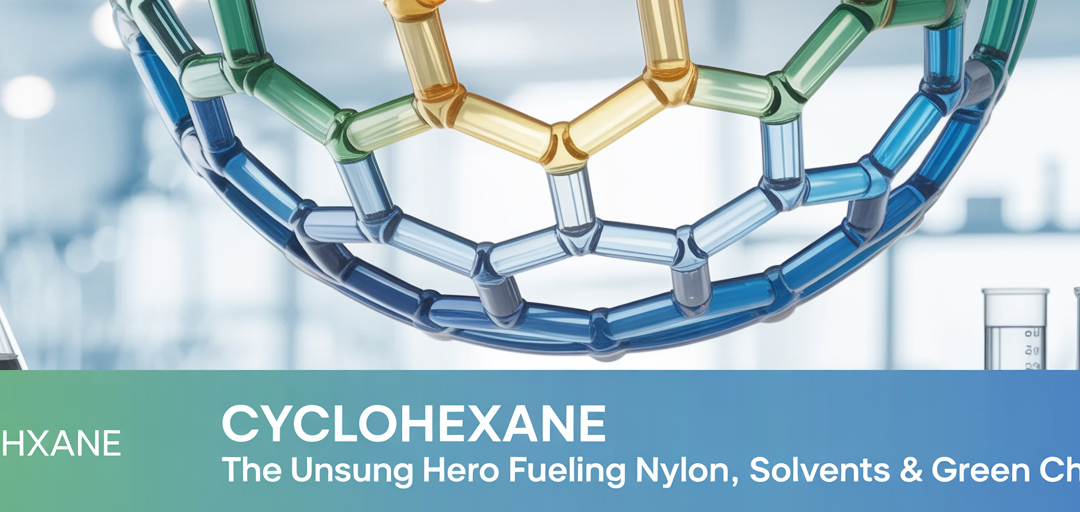
Cyclohexane rarely makes headlines, yet its colourless ring structure underpins global fibres, engineering plastics, and high-performance solvents. Analysts now forecast the compound’s market value to climb toward US $46 billion by 2034, propelled by Asian nylon demand, high-purity solvent applications, and a wave of sustainability initiatives aimed at decarbonising petrochemical building blocks. This industry trend analysis explores how cyclohexane is evolving from a commodity intermediate into a strategic enabler of green chemistry.
Chemical Identity and Main Production Routes
| Attribute | Details |
|---|---|
| Formula | C₆H₁₂ (saturated cyclo-aliphatic hydrocarbon) |
| Primary production | Liquid-phase catalytic hydrogenation of benzene at 150–220 °C, 30 bar |
| Emerging options | Vapour-phase hydrogenation with renewable H₂, bio-benzene feedstocks, catalytic depolymerisation of waste plastics |
| Key co-product | Heat integration often supplies low-pressure steam for adjacent adipic-acid or caprolactam plants |
Conventional units achieve < 1 % benzene slippage, but producers are optimising catalysts for higher selectivity and lower energy intensity, preparing for stricter Scope 1 emissions targets.
Market Snapshot and Growth Drivers
| Metric | 2024 | 2034 (projected) |
|---|---|---|
| Global volume | ~12 million t | > 16 million t |
| Value | US $29 billion | ~US $46 billion |
| Compound annual growth rate | 4.8 % | (2024 – 34) |
Key demand streams:
Nylon Intermediates (≈ 70 %): Oxidation to cyclohexanone / cyclohexanol mixes (KA oil) feeds adipic acid and caprolactam, essential for Nylon 6,6 and Nylon 6.
Solvents & Reagent Grades (≈ 15 %): Electronic-chemistry rinses, adhesive carriers, and paint strippers rely on high-purity cyclohexane’s low peroxide profile.
Specialty Chemical Synthesis (≈ 10 %): Cyclohexylamine, cyclohexanone oxime, and nylon-catalyst ligands.
Fuel Blending & Lab Use (≈ 5 %): High-octane petro-blends and analytical standards.
Demand correlates tightly with automotive output, textile consumption, and infrastructure build-outs—sectors rebounding post-pandemic and fuelling steady capacity additions across Asia-Pacific.
Applications Powering Multi-Sector Growth
Nylon value chain
Cyclohexane’s oxidation efficiency directly impacts adipic-acid economics. Integrated complexes in China, Singapore, and the US Gulf Coast now co-locate hydrogenation, KA oxidisers, and adipic reactors to trim logistics, cut inventories, and capture waste heat—reducing per-tonne CO₂e by up to 15 %.
Solvent markets
Battery-grade cyclohexane—stripped to single-digit ppb water and metals—supports N-methylpyrrolidone replacement in EV anode lines, while pharma API synthesis employs it for crystallisation steps sensitive to peroxide formation.
Advanced coatings
Cycloaliphatic diisocyanates derived from cyclohexane provide superior UV stability in clearcoats and wind-blade composites. Their growth echoes end-user push for longer-lived, lighter structures.
Sustainability Transitions and Alternative Feedstocks
| Pathway | Feedstock | Status | GHG reduction potential* |
|---|---|---|---|
| Bio-benzene hydrogenation | Lignin-derived aromatics, bio-toluene | Pilot | 50 – 70 % |
| CO₂-to-benzene routes | Electro-aromatisation of captured CO₂ | Lab | 80 – 90 % |
| Advanced plastics recycling | Pyrolytic oil upgrading to benzene/cyclohexane | Demo | 30 – 50 % |
| Renewable H₂ integration | Electrolytic hydrogen in legacy units | Commercial trials | 10 – 25 % |
*Lifecycle CO₂e reduction vs. conventional benzene–steam reformer hydrogen approach.
Producers are also exploring oxidative dehydrogenation loops that recycle H₂ generated downstream, further shrinking external gas demand.
Regional and Competitive Landscape
Asia-Pacific
Accounts for more than half of global capacity. Major complexes in China (Yangtze Delta, Fujian) couple cyclohexane with adipic acid and caprolactam mega-projects, leveraging competitive coal-to-chemicals syngas and captive benzene.
North America
US Gulf Coast benefits from shale-derived benzene and established nylon supply chains. Investments focus on retrofitting hydrogenation units for renewable hydrogen blends and digital twin optimisation.
Europe
Capacity rationalisation continues amid high energy prices, yet niche producers target low-carbon, bio-circular feedstocks under EU Green Deal incentives. Rotterdam and Antwerp hubs are trialling waste-plastic-to-cyclohexane pilots feeding local engineering-polymer plants.
Middle East
Integrated refinery-petchem parks in Saudi Arabia and the UAE supply cost-advantaged benzene, positioning the region as a swing exporter for Asian nylon producers.
Top five suppliers control roughly 45 % of merchant trade, but rising self-sufficiency in China is reshaping long-haul flows.
Green Chemistry Alternatives
Bio-cyclohexane blends entering trial runs in speciality solvent grades where a 30 % renewable content claim unlocks eco-label premiums.
Electrochemical benzene hydrogenation delivers on-demand production at distributed sites—promising for niche pharmaceutical or battery-material hubs.
Enzymatic benzene reduction under development uses engineered hydrogenases, opening a biocatalytic route that eliminates metal catalysts.
Cost parity with fossil pathways remains elusive but carbon-border adjustment mechanisms and brand-level carbon fees could accelerate adoption this decade.
Market Projections to 2034
| Segment | CAGR (2024 – 34) | Share of 2034 volume |
|---|---|---|
| Nylon intermediates | 5.1 % | 72 % |
| High-purity solvents | 4.3 % | 13 % |
| Specialty derivatives | 3.8 % | 10 % |
| Fuel & misc. | 2.2 % | 5 % |
Overall demand is set to cross 16 million t by 2034, with Asia adding two-thirds of net growth. Conservative forecasts assume modest bio-route penetration (< 8 % share), but accelerated policy support could lift renewables to double-digit share and nudge total market value beyond US $50 billion.
Conclusion
Cyclohexane may be an unsung hydrocarbon, yet it fuels the essential materials of modern life—from nylon-reinforced airbags to high-performance EV coatings. With sustainability imperatives mounting, producers and downstream users are racing to decouple cyclohexane’s value from fossil carbon through renewable hydrogen, bio-aromatic feeds, and circular recycling. As these pathways scale, the molecule’s journey from commodity to climate-smart building block will determine how smoothly the nylon and solvent industries steer toward a US $46 billion future—one ring at a time.