
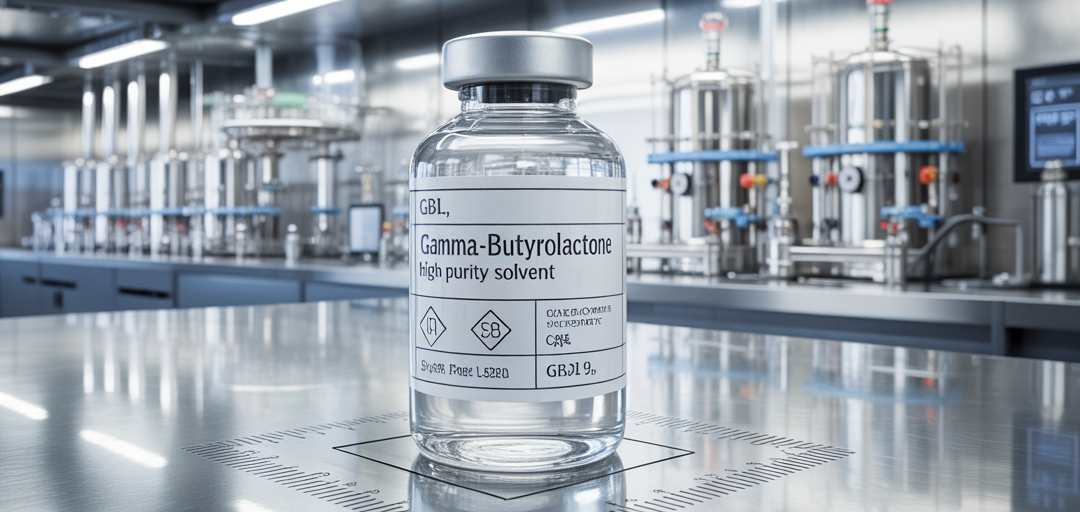
Gamma-butyrolactone, usually shortened to GBL, is one of those chemicals that rarely gets public attention but sits inside several technically demanding supply chains. It is a polar, water-miscible, high-boiling solvent and intermediate used across electronics cleaning, pharmaceutical synthesis, agrochemical formulation, specialty coatings and polyurethane systems. It also acts as an upstream building block for pyrrolidones such as 2-pyrrolidone and N-methyl-2-pyrrolidone, both of which are commercially significant in their own right.
That breadth explains why GBL continues to matter even as individual end markets shift. In electronics, it is valued for strong solvency, chemical stability and a wide liquid range. In pharmaceutical and fine chemical manufacturing, it is useful as a synthetic intermediate rather than just a carrier solvent. In polyurethanes and coatings, it appears where formulation control, viscosity management or speciality resin processing are important. These are not low-value, commoditised uses. They are performance-led applications where purity, process consistency and regulatory handling matter.
The market story, however, needs care. Public market estimates for GBL vary far more than the headline claims often suggest. Some 2025 market summaries place the global market at around USD 4.0 billion in 2024 and project it towards roughly USD 4.8 billion to USD 5.9 billion by 2032. Other public estimates are materially lower, with one 2025 summary putting the market at about USD 711 million in 2023 and just above USD 1 billion by 2030. That range is too wide to treat as a settled consensus. The most defensible conclusion is that GBL remains a meaningful speciality solvent market with steady growth, but published totals differ sharply depending on methodology, product scope, geography and whether downstream derivatives are included.
What is less disputed is the direction of travel. Semiconductor demand is rising, and high-purity solvent needs are rising with it. Global semiconductor sales reached roughly USD 792 billion in 2025 according to the Semiconductor Industry Association, underlining the strength of the electronics supply chain. Producers have responded by investing in higher-purity GBL output, including dedicated capacity expansions aimed at semiconductor cleaning and capacitor electrolyte applications. Against that backdrop, GBL is best understood not as a generic solvent, but as a grade-sensitive material serving precision manufacturing.
Chemistry and core properties
GBL is the simplest four-carbon lactone, with the formula C₄H₆O₂. At room temperature it is a colourless liquid, hygroscopic and fully miscible with water. Its commercial usefulness comes from a combination of high polarity, comparatively low freezing point, high boiling point and broad compatibility with many organic media. BASF’s technical literature describes it as miscible with water, alcohols, ketones, esters and aromatic hydrocarbons, while noting more limited solubility in aliphatic and cycloaliphatic hydrocarbons.
From a handling perspective, GBL is attractive because it remains liquid across a wide temperature range. Typical published data place its melting point near -43.5°C and its boiling point around 204–206°C. That wide liquid range is useful in industrial cleaning, extraction and process chemistry because it supports stable operation in systems where lower-boiling solvents may evaporate too readily or require tighter vapour management.
It also has strong solvency for polar and semi-polar systems. That is why GBL appears in photochemical etching, electronics cleaning, speciality resin processing and certain dyeing or coating applications. In intermediate chemistry, its ring structure also makes it a practical precursor to pyrrolidones and selected butyric acid derivatives.
Core property snapshot
| Property | Gamma-butyrolactone |
|---|---|
| Chemical formula | C₄H₆O₂ |
| CAS number | 96-48-0 |
| Physical form | Colourless liquid |
| Typical melting point | about -43.5°C |
| Typical boiling point | about 204–206°C |
| Density at 20–25°C | about 1.12–1.13 g/cm³ |
| Water solubility | Miscible |
| Key commercial functions | Solvent, intermediate, process aid |
From a buyer’s perspective, those properties translate into three commercial benefits. First, GBL can dissolve materials that are awkward in lower-polarity systems. Second, it can be handled in applications where temperature variability would cause other solvents to solidify or evaporate too aggressively. Third, it offers a route into downstream derivative chemistry, which means its value often depends on where it sits in a broader process chain rather than on solvent use alone.
Production routes and manufacturing overview
Industrial GBL is typically tied to the C4 value chain, especially 1,4-butanediol, maleic anhydride and related hydrogenation chemistry. One established production route is the dehydrogenation of 1,4-butanediol over copper-based catalysts, yielding GBL at high selectivity. Another industrial route appears within hydrogenation systems built around maleic anhydride or dialkyl maleates, where GBL, 1,4-butanediol and tetrahydrofuran can be produced in related reaction networks depending on catalyst choice and operating conditions.
That matters commercially because GBL is not usually a stand-alone feedstock story. Its economics are tied to upstream C4 raw materials, hydrogenation technology, catalyst efficiency and the wider balance between GBL, BDO and THF markets. When upstream maleic anhydride or BDO conditions tighten, GBL pricing and availability can also move.
More recent scientific work continues to focus on improving selectivity across this reaction family. Research in 2024 and 2025 highlights how catalyst design can shift outcomes between GBL, BDO and THF, depending on whether the producer wants selective hydrogenation or deeper hydrogenation. For industrial buyers, the implication is simple: GBL supply is partly a solvent story, but also a derivatives balancing story.
Manufacturing route comparison
| Route | Main feedstock base | Commercial status | Main strength | Main watchpoint |
|---|---|---|---|---|
| Dehydrogenation of 1,4-butanediol | 1,4-BDO | Established | Mature process, good selectivity | Dependent on BDO economics |
| Maleic anhydride hydrogenation network | Maleic anhydride / maleates | Established to developing variations | Integrated C4 platform; co-product flexibility | Product slate depends on catalyst and conditions |
| Dialkyl maleate hydrogenation | Maleate esters | Industrially referenced | Can co-produce GBL, BDO and THF | Separation and optimisation complexity |
The sustainability conversation is still secondary compared with battery solvents and some other chemical markets, but it is becoming more relevant. Producers and buyers are under growing pressure to understand carbon intensity, feedstock origin and energy efficiency. In practice, that means GBL may remain petrochemical in origin for the foreseeable future, but customers in electronics and pharma are increasingly asking more detailed questions about traceability and process control.
Current market uses and industry applications
The most commercially useful way to understand GBL is by application story rather than by a single end market.
In electronics, GBL is used where strong solvency and high purity are required. BASF’s product literature explicitly lists photochemical etching, electrolytes of small batteries or capacitors and surface treatment roles. BASF has also referenced customer use in circuit board cleaning. Mitsubishi Chemical described GBL in 2023 as a high-purity solvent used in electrolytes for capacitors and in semiconductor parts cleaning solutions, and announced a production increase to address rising demand. That combination of product description and capacity action is an important signal: electronics-grade demand is not merely theoretical; suppliers are investing against it.
In pharmaceuticals and fine chemicals, GBL functions more as an intermediate than a process solvent. BASF notes that it may be formed as an intermediate in vitamin and pharmaceutical production, while Ashland positions GBL as a precursor to 2-pyrrolidone and alkyl pyrrolidones. That derivative pathway matters because pyrrolidones remain widely used in coatings, inks, formulations and pharmaceutical processing. In other words, part of GBL demand is indirect: customers may not be buying GBL for the final formulation, but for the chemistry it unlocks.
In polyurethane-related systems, GBL appears in speciality formulation roles such as viscosity modification. This is not the largest or most visible use, but it is commercially relevant because it reinforces GBL’s identity as a performance solvent rather than a bulk carrier.
Agrochemical and speciality formulation uses are also meaningful. BASF and Ashland both reference pesticide-related applications. These tend to be more formulation-specific than headline markets, but they add stability to demand because they diversify GBL beyond one sector.
Application and grade view
| Application area | Why GBL is used | Typical grade priority |
|---|---|---|
| Semiconductor and electronics cleaning | Strong solvency, low residue potential, stable liquid range | Electronic or high-purity grade |
| Capacitor and electrolyte systems | Electrical and solvent properties | High-purity / electronic grade |
| Pharmaceutical and fine chemical synthesis | Useful intermediate and reaction medium | Pharma or synthesis grade |
| Pyrrolidone derivatives | Precursor to 2-pyrrolidone and alkyl pyrrolidones | Intermediate / production grade |
| Polyurethanes and specialty resins | Viscosity and formulation support | Industrial or high-purity grade |
| Agrochemical formulations | Carrier solvent and formulation aid | Industrial grade, application dependent |
For a business audience, the key point is that GBL’s value is not concentrated in a single blockbuster application. It comes from cross-sector utility, with electronics and derivative chemistry providing the most strategically interesting demand signals.
Emerging growth areas
The clearest near-term growth area is electronics-grade supply. Semiconductor production is expanding globally, and the associated demand for high-purity process chemicals is rising alongside it. The Semiconductor Industry Association reported that global semiconductor sales grew by 25.6% in 2025, while WSTS has also projected continued growth into 2026. GBL will not capture that growth automatically, but materials already used in semiconductor cleaning and component processing stand to benefit from the broader expansion in chip fabrication and advanced electronics manufacturing.
A second growth area is higher-purity differentiation. In many chemical markets, “purity” is a simple product specification. In GBL, it is increasingly a market segmentation tool. Public market summaries suggest that high-purity GBL grades account for a large share of revenue, and supplier actions support that view. The commercial logic is straightforward: customers in semiconductors, electronics and pharmaceutical processing are prepared to pay for tighter impurity control because contamination risk is expensive.
A third area is derivative-led growth. GBL is not only sold as GBL. Its commercial footprint extends into pyrrolidone chemistry, which supports inks, coatings, pharmaceuticals and speciality formulations. Where 2-pyrrolidone and related solvents remain relevant, GBL has indirect demand support.
A fourth growth area is regional investment in Asia-Pacific. Multiple public market reports place Asia-Pacific as the largest regional market, often with around 45% share. That is consistent with the concentration of electronics, chemicals and pharmaceutical manufacturing in China, Japan, South Korea, Taiwan and South-East Asia. Although these numbers come from market research rather than official trade statistics, the regional logic is credible.
Simple demand map
Indicative strength of GBL demand drivers
Electronics / semiconductors | ██████████
Pharma intermediates | ███████
Pyrrolidone derivatives | ████████
Polyurethanes / specialty resins | █████
Agrochemical formulations | ████
Comparison with related solvents and intermediates
GBL is often discussed alongside N-methyl-2-pyrrolidone, 2-pyrrolidone and sometimes tetrahydrofuran or 1,4-butanediol, but they do different jobs in the value chain.
GBL sits in an interesting middle position. It is a solvent in its own right, but also a precursor. 2-pyrrolidone and NMP are downstream derivatives with broader established use in coatings, inks and process chemistry. THF, by contrast, is a lower-boiling cyclic ether with a different solvency profile and a stronger identity in polymer and reaction chemistry rather than as a direct replacement for GBL.
The commercial question is not whether GBL “beats” these materials. It is where in the chain the value is captured. A producer integrated from maleic anhydride or BDO through to GBL and then onward to pyrrolidones has more flexibility than a stand-alone GBL merchant. That flexibility matters in pricing, product slate management and customer retention.
Challenges, constraints, safety and regulatory considerations
GBL’s main commercial complication is regulatory control. Unlike many industrial solvents, it sits under close scrutiny because of diversion risks. In the United States, DEA documentation confirms that GBL is a List I chemical. That status does not prevent industrial use, but it does increase compliance expectations around distribution, customer screening, documentation and traceability. International precursor monitoring bodies also continue to track trade in GBL and related substances.
In Europe, GBL is registered under REACH, and ECHA’s substance information indicates hazard classifications including harmful if swallowed and serious eye damage based on notified classifications. Safety data sheets also flag irritation and handling precautions, along with combustible-liquid behaviour and flash points typically near 98°C. This is manageable in industrial settings, but it means GBL procurement is not simply a matter of buying a drum and slotting it into a line. Storage, ventilation, worker protection, customer qualification and transport compliance all matter.
Raw material exposure is another constraint. Because GBL is tied to the C4 derivatives chain, feedstock conditions in maleic anhydride, BDO and hydrogenation systems can affect supply economics. For buyers in electronics or pharma, that means qualification of alternative suppliers is prudent even when the incumbent source is reliable.
Finally, there is a substitution risk. In some applications, GBL competes with other polar aprotic solvents or process-specific cleaners. It is unlikely to disappear from high-value uses where its properties are well matched, but its position is strongest where technical need is clear and weakest where it is treated as a generic solvent.
Practical sourcing and grade considerations
For procurement teams, the critical distinction is grade, not merely price. Industrial-grade GBL may be entirely adequate for some resin, formulation or intermediate uses. Electronic-grade or very high-purity GBL is a different commercial category, because trace impurities can affect semiconductor cleaning outcomes, capacitor performance or downstream synthetic reliability.
That makes supplier assessment more important than headline assay alone. Buyers should examine impurity profile, moisture control, packaging type, batch consistency, analytical method, regional warehousing and change-control discipline. In electronics-related applications, the real commercial cost sits in process disruption and yield loss, not in the solvent price itself.
For pharmaceutical or fine chemical users, regulatory paperwork and supply chain transparency become equally important. The product may be chemically identical, but procurement risk changes when the customer needs fuller documentation, tighter traceability or audit-ready supply records.
The practical conclusion is that GBL is increasingly a quality-of-supply market. Commodity logic still matters, especially where industrial grades are sufficient, but the more strategic revenue sits in customers who buy performance and documentation rather than just volume.
Gamma-butyrolactone remains a commercially important solvent and intermediate because it serves several technically demanding markets at once. Its combination of high polarity, broad liquid range and derivative chemistry makes it relevant in electronics, pharmaceuticals, speciality formulations and the wider pyrrolidone value chain.
The market outlook is positive, but not as numerically tidy as some headlines imply. Public forecasts differ sharply, so it is safer to describe GBL as a steadily growing speciality market than to anchor the story to a single market size claim. What is more certain is that high-purity demand is strengthening, especially where semiconductors, capacitor materials and precision cleaning are concerned.
For producers and distributors, the opportunity lies in grade management, regional reliability and derivative integration. For buyers, the main commercial question is not whether GBL is useful, but whether the chosen supplier can deliver the right grade, documentation and compliance standard for the application. In that sense, GBL is not merely a solvent story. It is a supply-chain discipline story.