
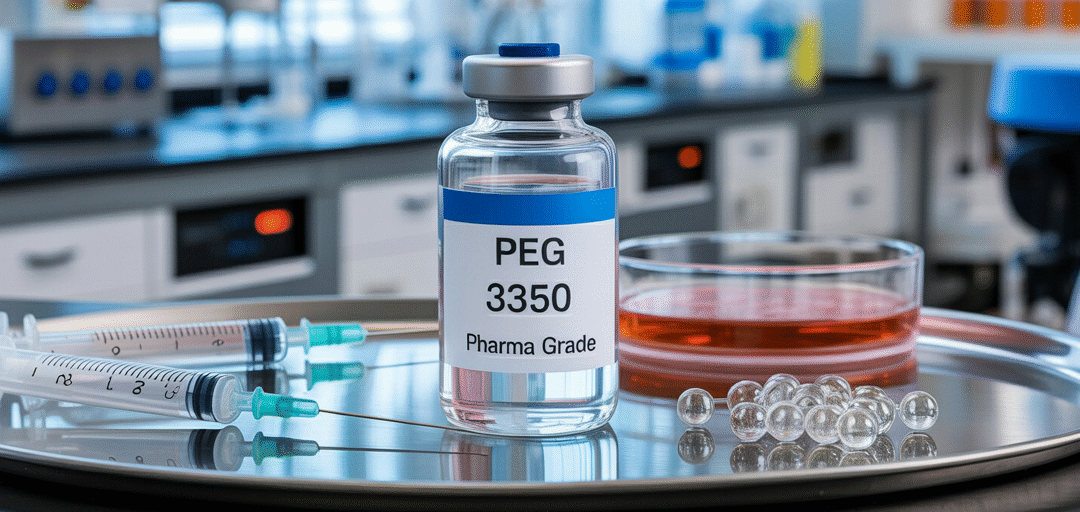
Polyethylene glycol (PEG) has long been the quiet workhorse of pharmacy—slipping into ointment bases, lubricating tablets, and smoothing manufacturing kinks without fanfare. Over the past decade, however, pharma-grade PEG has stepped into a starring role. It stabilises lipid nanoparticles (LNPs) in mRNA vaccines, extends the half-life of life-saving biologics through PEGylation, enables long-acting injectables and depot systems, and even anchors the bioinks of 3D-printed tissues. As global demand for biologics, advanced therapies, and patient-friendly dosage forms grows, PEG’s importance is accelerating—in both established and emerging modalities.
This long-form analysis unpacks the market trajectory, the science behind PEG’s performance, the expanding application landscape, and the regulatory and sustainability issues that now shape procurement and formulation choices.
The market at a glance
The PEG market sits in the mid-single-digit billions of dollars today and is on a clear growth trajectory through the early 2030s, buoyed by healthcare, personal care, and industrial demand. Within this broader pie, pharma-grade PEG accounts for an outsized strategic impact because advanced therapies rely on qualities—biocompatibility, tunable hydrophilicity, and process consistency—that generic grades cannot always provide. Analysts broadly agree on steady growth to the early 2030s, with some tracking to the high single-digit billions and others projecting a climb toward the ten-billion mark as biologics and mRNA-class products proliferate.
Why the momentum?
Biologics and biosimilars are expanding, and PEGylation remains a proven way to extend exposure, reduce dosing frequency, and improve patient adherence.
mRNA and other nucleic-acid therapies use PEG-lipids to modulate LNP size, surface charge, and circulation time, improving stability and delivery performance.
Patient-centric reformulation trends (topicals, ophthalmics, injectables with smoother rheology) favour excipients with clean safety profiles, pharmacopeial coverage, and robust supply chains—boxes PEG ticks.
What makes PEG so useful?
PEG is a polyether formed by polymerising ethylene oxide; by varying molecular weight (MW) and architecture (linear, multi-arm), formulators tune properties across a wide range:
Solvation and wetting. PEG’s ether oxygens coordinate water, improving wetting, spreading, and dissolution for many APIs.
Plasticisation and rheology control. From tablet films to semisolid bases, PEG grades modulate viscosity and mechanical feel.
Biocompatibility and “stealth”. Covalently attached PEG chains (PEGylation) increase hydrodynamic radius, reduce proteolysis, and shield proteins from opsonisation—prolonging circulation time.
Surface engineering. PEGylated lipids on nanoparticle surfaces suppress protein corona formation and reduce reticuloendothelial system uptake, extending systemic exposure.
Typical pharma uses by grade
| PEG grade (approx. MW) | Physical form at room temp | Common routes | Typical roles in formulations |
|---|---|---|---|
| 200–600 | Low-viscosity liquids | Oral, topical | Solvent, co-solvent, plasticiser, wetting agent |
| 1000–2000 | Waxy/pasty | Topical, rectal, oral | Ointment base, suppository base, plasticiser |
| 3000–8000 | Free-flowing solids | Oral, parenteral (as excipient) | Tablet/capsule lubricant, binder; matrix former |
| 10k–40k+ | Solids | Parenteral (as PEGylation polymer) | Covalent conjugation to proteins/aptamers (“PEGylation”) |
| PEG-lipids (e.g., PEG-2000 conjugates) | Amphiphilic | Parenteral (LNPs) | LNP steric stabiliser, circulation control |
PEGylation science in brief
PEGylation covalently attaches PEG chains to biologics (proteins, enzymes, aptamers) or small molecules. The resulting increase in hydrodynamic radius reduces renal clearance and proteolysis, often:
Extending half-life from hours to days
Decreasing dosing frequency
Improving exposure–response and patient adherence
Reducing immunogenicity in some contexts (while introducing its own immunological considerations)
Selected approved PEGylated therapeutics (illustrative)
| Product (non-proprietary) | Modality | Indication | Benefit of PEGylation |
|---|---|---|---|
| Pegfilgrastim | G-CSF protein | Neutropenia | Long-acting vs filgrastim; fewer injections |
| Peginterferon alfa-2a/-2b | Protein cytokines | Hepatitis C (legacy), oncology | Extended exposure; modified dosing |
| Pegaspargase | Enzyme | ALL | Prolonged activity; altered immunogenicity profile |
| Certolizumab pegol | PEGylated Fab | Autoimmune diseases | PEG tail contributes to PK; lacks Fc-mediated effects |
| Pegloticase | Enzyme | Refractory chronic gout | Sustained urate-lowering via longer half-life |
mRNA vaccines and PEG-lipids
The COVID-19 era spotlighted PEG-lipids as essential LNP components. PEGylated lipids, typically with PEG ~2000, create a hydrophilic steric barrier at the nanoparticle surface, helping to:
Control particle size and surface charge
Reduce aggregation during manufacturing and storage
Modulate protein corona formation and cellular uptake, tuning biodistribution and efficacy
Extend circulation time, improving delivery to target tissues
The success of mRNA vaccination platforms has spurred broader nucleic-acid therapy pipelines. That, in turn, sustains demand for high-purity PEG-lipids and motivates fine-control research on PEG chain length, density, and linker chemistry to balance stability with endosomal escape.
Beyond injectables: ophthalmics, topicals, and 3D bioprinting
Ophthalmic delivery. PEG functions as a wetting agent, viscosity modifier, and component in advanced ocular systems (e.g., in situ gels, micelles, or nanoparticles). Its track record of tolerability and pharmacopeial status make it a go-to excipient in eye drops and periocular products.
Topical and transdermal. PEG grades tailor rheology and skin feel, enhance API solubilisation, and improve spreadability. In patches and semisolids, its water affinity supports predictable release profiles.
3D bioprinting and tissue engineering. PEG-based hydrogels (PEGDA/PEGDMA) serve as bioinks or scaffold matrices thanks to tunable crosslinking, water uptake, and mechanical properties—enabling constructs that support cell viability, nutrient diffusion, and controlled degradation.
Quality, monographs, and what “pharma-grade” really means
For drug products, it’s not enough that a PEG “works”; it must be manufactured, tested, and documented to pharmaceutical quality standards:
Pharmacopeial monographs (USP–NF, Ph. Eur., JP) define identity, purity, and impurity tests for PEG grades and are periodically revised to reflect analytical advances and new impurity risks.
FDA’s Inactive Ingredient Database (IID) lists prior uses and maximum levels by route—a practical compass for formulators seeking regulatory precedent.
IPEC–PQG GMP guidance provides a harmonised blueprint for excipient manufacturing controls, traceability, and distribution practices that sponsors increasingly expect from suppliers.
Supplier “high-purity” or “super-refined” lines aim to minimise reactive impurities (peroxides, aldehydes) that can degrade sensitive APIs, improving stability and shelf-life.
Impurities and analytical vigilance
Because PEG is produced from ethylene oxide (EO) and can carry process-related residues, the industry pays special attention to:
Residual EO and 1,4-dioxane (a by-product via diethylene glycol dehydration), monitored by sensitive methods and subject to strict internal or pharmacopeial limits.
Residual ethylene glycol/diethylene glycol, per historic safety concerns in excipients and solvents.
Peroxides and aldehydes that can degrade oxidation-sensitive APIs.
Analytical method development (including modern mass-spectrometric techniques) and supplier controls are central to meeting evolving expectations.
Safety & immunology: anti-PEG antibodies and allergic reactions
PEG is widely regarded as low-toxicity and biocompatible. However, PEG’s visibility has increased clinical scrutiny:
Allergic reactions to PEG are rare, yet recognised; vaccination programmes prompted targeted guidance for individuals with known PEG allergy histories.
Anti-PEG antibodies (pre-existing in a minority of the population or induced after exposure to PEGylated products) are actively researched because they may impact the pharmacology of PEGylated drugs or LNP-based therapeutics.
Formulation strategies now consider PEG density, chain length, and alternative stealth polymers (e.g., polysarcosine, poly(2-oxazoline), zwitterionic polymers) when immunogenicity risks warrant.
PEG vs emerging “stealth” alternatives
| Polymer | Key attributes | Potential advantages | Typical challenges |
|---|---|---|---|
| PEG | Gold-standard stealth; approved legacy | Broad familiarity, compendial status | Anti-PEG antibodies in some patients |
| Polysarcosine | Peptoid-based, hydrophilic | Lower protein adsorption; biodegradability potential | Regulatory/CMC familiarity still growing |
| Poly(2-oxazoline) | Tunable hydrophilicity | Strong stealth behaviour | Fewer precedents in approved products |
| Zwitterionics | Super-hydrophilic, protein-repellent | Excellent antifouling | Synthesis, scale-up, and regulatory playbooks evolving |
Formulation playbook: getting PEG choices right
1) Start with the target product profile (TPP). Dose frequency, route, viscosity window, and device constraints drive MW and architecture selection.
2) Match grade to route.
Oral/topical: liquids (PEG 200–600) for solvency or plasticisation; higher MW for matrix integrity.
Parenteral: tight impurity control, low peroxide/aldehyde content; verify IID precedents.
PEGylation: define chain length/architecture to balance half-life gains against activity and potential immunogenicity.
3) Design for stability.
Control peroxide formation and aldehydes; consider “super-refined” supplier lines.
Evaluate API interactions (e.g., oxidation, acylation, or covalent adducts).
Validate container-closure compatibility and storage conditions.
4) For LNPs or nanocarriers.
Optimise PEG-lipid percentage to avoid aggregation yet maintain cellular uptake.
Tune PEG chain length (often ~2 kDa) and anchor chemistry (e.g., acyl chain length) to control desorption rates in vivo.
5) Document everything.
Reference pharmacopeial compliance, supplier GMP audits (IPEC–PQG), and IID levels.
Build a robust control strategy for EO, 1,4-dioxane, and other process-related impurities.
Regulatory landscape: what reviewers look for
Monograph compliance and clear grade definitions (MW distribution, viscosity ranges).
Justification of excipient levels vs IID precedents or literature (especially for parenterals and novel routes).
Impurity control plans and validated analytical methods for EO, 1,4-dioxane, and residual solvents per ICH Q3C where applicable.
Risk assessments for immunogenicity where PEG is surface-exposed (e.g., LNPs) or covalently attached (PEGylated biologics).
Change control: defining supplier change notification and comparability protocols to avoid drift in performance-critical attributes.
Sustainability: from EO to bio-attributed PEG
Traditional PEG is fossil-based via ethylene → ethylene oxide → PEG. Sustainability-minded buyers increasingly ask: can the chain be de-fossilised?
Bio-ethanol to bio-ethylene (via dehydration) is already commercial at scale. As bio-ethylene expands, bio-attributed ethylene oxide becomes more accessible to downstream derivatives—PEG included.
Life-cycle assessments suggest meaningful GHG reductions for bio-routes, though outcomes depend on feedstock, energy, and land-use assumptions.
Book-and-claim/ISCC-certified bio-attribution models allow incremental decarbonisation now, while truly biogenic EO volumes scale.
For buyers, this translates to practical steps: engage suppliers on bio-attributed ethylene, request ISCC certification, and track the LCAs behind sustainability claims. Expect more PEG offerings with documented carbon footprints in the coming years.
Market outlook by segment
Biologics/PEGylation. Continued but selective growth; competition from Fc engineering, albumin fusions, and alternative stealth polymers will refine PEG’s use rather than replace it wholesale.
mRNA and nucleic-acid delivery. Strong pipeline activity in vaccines, rare diseases, and oncology keeps demand high for PEG-lipids—tempered by research into alternatives that mitigate anti-PEG antibody issues.
Ophthalmic/topical/oral reformulations. Steady expansion, underpinned by PEG’s safety record, rheology tuning, and solubilisation prowess.
3D printing/tissue engineering. Early but dynamic: PEG-based hydrogels remain a leading synthetic scaffold platform thanks to biocompatibility and chemistry control.
Illustrative market trajectory (overall PEG, not pharma-only)
Revenue (US$ billions)
8 |                                   █
7 |                              ██████
6 |                        ███████
5 |                   █████
4 |             █████
3 |        ████
2 |   ███
1 |
    2024   2026   2028   2030   2032   2034

Note: Schematic projection based on multiple analyst estimates showing a climb from ~US$4–5B in 2024 toward ~US$7–10B by early 2030s. Actual paths vary by source and segment mix.
Practical sourcing checklist for pharma buyers
Define function (solvent, plasticiser, PEGylation polymer, PEG-lipid) and route first.
Lock specification: MW range, viscosity, peroxide/aldehyde maxima, residual EO/1,4-dioxane limits; state analytical methods and acceptance criteria.
Demand documentation: full CoA, pharmacopeial compliance (USP–NF/Ph. Eur./JP), IID evidence, nitrosamine cross-checks where relevant, and IPEC–PQG GMP attestations.
Qualify redundancy: at least two suppliers or dual-site strategy to mitigate supply disruptions.
Explore sustainability: bio-attributed ethylene pathways and ISCC-certified mass balance where available.
Conclusion
Pharma-grade PEG is no longer just the “lubricant in the background.” It is central to modern drug delivery—underpinning the pharmacokinetics of PEGylated biologics, the stability of LNPs, the elegance of patient-friendly topicals and ophthalmics, and the promise of printable tissues. The next decade will reward formulators and procurement teams that treat PEG as a strategic enabler: selecting grades with intention, managing impurities with modern analytics, anticipating immunology and regulatory expectations, and asking sharper questions about carbon intensity and bio-attribution.
PEG’s power lies in its versatility. Harnessed wisely, it helps therapies go further, last longer, and reach the patients who need them—safely and reliably.
References
FDA Inactive Ingredient Database (IID) and guidance resources for excipient precedents. (U.S. Food and Drug Administration)
IPEC–PQG GMP guidance for excipient manufacturing and distribution controls. (ipec-europe.org)
PEG-lipids in LNP delivery: function, density, and performance considerations. (beilstein-journals.org)
3D bioprinting and PEG-based hydrogels (PEGDA/PEGDMA) in tissue engineering. (PMC)
Safety and immunology: anti-PEG antibodies and allergy guidance in the context of vaccines. (Nature)
COVID-19 mRNA vaccine composition (PEG-lipid component in LNPs). (canada.ca)
Residual EO/1,4-dioxane control and analytical approaches; relevant standards. (European Medicines Agency (EMA))