
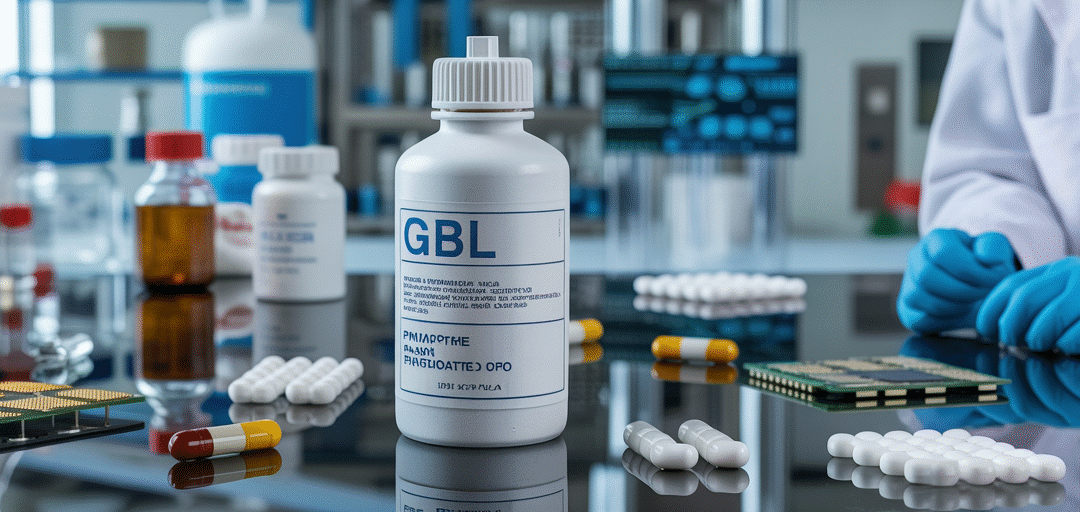
Gamma-butyrolactone (GBL) is one of those quiet, workhorse molecules whose impact far exceeds its fame. In 2022, the global GBL market was widely estimated around the mid-$3.6–3.7 billion mark and is tracking toward roughly $5 billion by 2032 on the back of electronics, capacitor electrolytes, photoresist processing, polyurethane systems, and pyrrolidone derivatives that feed pharmaceuticals and advanced materials. What makes GBL especially interesting today isn’t only its solvency power and dielectric profile, but the way it sits at the crossroads of semiconductor purity, greener feedstocks (bio-BDO → GBL), and tightening regulatory oversight. This long-form briefing unpacks the chemistry, the applications, the grades, the supply chain, and the outlook—plus the practical buying and compliance considerations that matter on the plant floor.
What GBL is—and why it matters now
GBL (C₄H₆O₂) is a five-membered lactone: a colourless, hygroscopic liquid with a high boiling point (~204 °C), moderate vapour pressure, polar character, and strong solvency for polymers and organics. It is miscible with water and many organics, offering a useful combination of high dielectric constant and low volatility. Commercially, GBL is produced by dehydrogenating 1,4-butanediol (BDO) over copper catalysts, or by hydrogenating maleic/succinic anhydride streams in modern integrated units. Those routes link GBL to two big upstream levers: butane/benzene-to-maleic anhydride on the petro side, and fermentation-based succinic acid or sugar-based bio-BDO on the renewable side.
The timing is favourable. Electronics manufacturers demand ultra-low metals and water in solvents for lithography and wet cleans; capacitor makers look for high-dielectric, low-volatility solvents; polyurethane and coating formulators need powerful, safer-handling alternatives to legacy aprotic solvents in specific steps. GBL touches all of those—directly as a solvent or indirectly as a precursor to 2-pyrrolidone and N-methyl-2-pyrrolidone (NMP).
Electronics: photoresist processing, strippers, and capacitor electrolytes
Photoresist & wet processing. Electronic-grade GBL appears in resist casting and stripping formulations thanks to its polarity, stability, and film-forming behaviour. At nodes where trace metals at the parts-per-billion level can tank yields, solvent purity is strategic: water at low-ppm, sodium/potassium below detection, and tight organics control. Specialist electronics suppliers offer “EL/EL-GBL” and similar grades with rigorous metals and water specifications, supported by ICP-MS certificates and micro-filters in packaging and logistics chains.
Electrolytic capacitors. Aluminium electrolytic capacitors often use high dielectric constant organics as main solvents in the electrolyte. GBL is one of the canonical choices where elevated boiling point and stability help manage ripple current and lifetime; in some designs it sits alongside ethylene glycol (EG). For EV inverters, telecoms, and industrial drives, those incremental gains in solvent performance can translate into reliability margins.
Why electronics pull matters. Foundry capex and equipment upgrades cascade into solvent demand with a purity premium. Each percentage point swing in electronic-grade yields can justify moving from technical grade to ultra-pure GBL, and that uplifts the blended price pool for producers with the right purification trains.
Pharma & fine chemicals: the pyrrolidone highway
GBL is a backbone intermediate to 2-pyrrolidone (via ammonia) and N-methyl-2-pyrrolidone (NMP) (via monomethylamine), which in turn unlock PVP/PVPP polymers, pharma syntheses, agro actives, and specialty coatings. The chemistry is direct and mature, with continuous processes operating at elevated temperature and pressure over fixed-bed catalysts. For buyers, that means: where NMP/PVP volumes are healthy, GBL offtake is resilient; where NMP substitution pressures apply (e.g., in certain regulated uses), some demand may re-route toward alternative lactams/solvents—but GBL keeps relevance as an upstream swing molecule and as a niche solvent itself.
Polyurethanes, coatings & industrial cleaning
Polyurethane systems. GBL contributes in two ways. First, as a solvent for certain polyester polyols, adhesives, and specialty PU coatings where solvency, flash point (~98 °C) and compatibility are valued; second, indirectly via pyrrolidones common in PU-related processing. Market analyses increasingly cite polyurethane demand in construction/automotive as a GBL growth driver, especially in Asia-Pacific. While GBL is not a universal drop-in for NMP or DMF, it’s an important tool in the solvent selection kit for high-solids or specialty systems under VOC and worker-exposure pressure.
Industrial cleaning and precision degreasing. GBL’s solvency and slower evaporation facilitate residue removal on complex surfaces, often in blends engineered for safety and substrate compatibility. It shows up in high-performance paint strippers and precision cleaning where halogenated solvents are being engineered out.
Market size, momentum & a quick visual
Estimates vary by firm, but the consensus shape is similar: a mid-$3.6–3.7 billion base, low-single-digit CAGR, and an approach to ~$5 billion by 2032—as electronics, capacitors, polyurethane, industrial cleaning, agro and pharma keep pulling.
Global GBL Market (US$ Billion, indicative)
2022 | ████████████████ 3.6
2023 | █████████████████ 3.7
2026 | █████████████████████ 4.1
2029 | ████████████████████████ 4.5
2032 | ██████████████████████████ ~5.0
(Illustrative, based on multiple analyst trajectories; actual paths vary by region and grade mix.)
Grade anatomy: purity, water, and metals
Choosing the right grade is not box-ticking—it’s yield insurance, HSE compliance, and warranty protection. At a glance:
Table 1 — Typical commercial GBL grades and use cues
| Grade / Cue | Typical purity & spec cues* | Metals / particulates | Typical uses |
|---|---|---|---|
| Technical/Industrial | ≥99.5–99.7% assay; water ≤0.05% w/w; acid value in the few-hundred ppm range | Not controlled beyond standard chemical grade | Industrial cleaning, paint removers, resins/adhesives processing |
| Pharma/Reagent | ≥99.5–99.9% assay; tighter peroxide/acid specs; controlled bioburden/packaging | Low sodium/potassium; certifiable CoA lots | Intermediates to 2-pyrrolidone/NMP; reagent use |
| Electronic (“EL-GBL”) | ≥99.5–99.9% assay; water often at tens–hundreds of ppm; microfiltered packaging | Trace metals at very low ppm/ppb, particle specs | Photoresist formulation, strippers, wet cleans; capacitor electrolytes |
*Representative values; always confirm supplier CoA and ICP-MS limits for the target process window.
Table 2 — Where GBL earns its keep, and the measurable value
| Segment | What GBL does | Performance signal | Buyer value |
|---|---|---|---|
| Photoresist & litho | Casting/stripping solvent with polarity and stability | Film homogeneity, low ionic contamination | Yield, fewer line stoppers |
| Electrolytic capacitors | High-dielectric, high-bp solvent | ESR stability, longer life under ripple | Reliability, warranty risk control |
| Polyurethanes/coatings | Strong solvent in select PU/adhesives systems | Flow/leveling at lower VOC blend | HSE/permit compliance, finish quality |
| Pharma/fine chem via pyrrolidones | Precursor to 2-pyrrolidone/NMP | Robust continuous conversion routes | Supply optionality across derivatives |
| Industrial cleaning | Slow-evap, powerful solvency | Complex residue removal | Throughput, rework savings |
Supply chain: feedstocks, energy & the bio-swing
Petro routes. Two classic pathways dominate: (1) BDO dehydrogenation to GBL over copper catalysts, and (2) maleic anhydride esterification/hydrogenation sequences producing BDO/THF/GBL in flexible ratios. The “Davy/JM” integrated technology is notable for tuning co-product ratios and offers GBL extraction or recycle into BDO/THF pools depending on margins.
Bio routes. Fermentation-based succinic acid hydrogenation and bio-BDO (e.g., sugar-to-BDO) create renewable carbon routes into GBL. Commercial demonstrations in Europe have shown 30 kt/y-scale bio-BDO with significant lifecycle CO₂ reductions, enabling “bio-content” positioning for downstream polymers and specialty solvents. For buyers with Scope 3 targets, qualifying GBL derived from bio-BDO streams is a practical lever—provided the mass-balance and certification chain is watertight.
Feedstock risk radar. Maleic anhydride (from butane/benzene) and hydrogen costs add volatility; tight acetylene/formaldehyde routes to BDO are progressively less favoured. Energy pricing, regional maintenance turnarounds, and electronics demand cycles can tighten high-purity GBL premiums even when overall capacity looks comfortable.
Innovation watch: recyclable chemistries and energy carriers
Beyond incremental catalyst and purification tweaks, three innovations are worth tracking:
Closed-loop lactone/diol pairs. Reversible GBL ⇌ BDO chemistries are being explored for liquid organic hydrogen carriers and energy-efficient loops—if scale and catalyst lifetimes line up, they add optionality to integrated plants.
Poly(γ-butyrolactone) (PGBL). Advances in ring-opening and “chemically recyclable” polyesters keep GBL on the R&D map for circular materials, albeit not yet a volume sink.
Ultra-pure packaging & analytics. Electronics suppliers push beyond standard “99.9%” claims into metals-by-metals specs, in-line moisture control, and filtered container systems to protect solvent integrity to point of use.
HSE & regulatory reality check
GBL’s hazard profile includes eye irritation, CNS effects at high exposure, and a closed-cup flash point around ~98 °C. Appropriate engineering controls (local exhaust), PPE (chemical-resistant gloves, goggles), and inert storage are standard practice.
Critically, GBL is a controlled List I chemical in the U.S. due to its potential conversion to GHB; when intended for human consumption it may be treated as a Schedule I analogue. Mixtures above defined thresholds (e.g., >70% in many cases) and container size triggers bring recordkeeping, customer vetting, and reporting obligations. The EU treats GBL within the drug precursor framework (Reg. 273/2004 and implementing acts), with licensing/notification duties for economic operators. Industrial buyers should assume: KYC questionnaires, end-use declarations, order-pattern monitoring, and audit rights are part of the sales process. Build those touches into your procurement timeline to avoid bottlenecks.
Formulation & process notes that save time
Moisture management. Even tens of ppm water can perturb resist viscosity or electrolyte performance. Specify and verify Karl Fischer limits lot-by-lot for electronic applications; insist on nitrogen blanketing and tamper-evident closures.
Ion housekeeping. If you are casting or cleaning near active device areas, set explicit Na⁺/K⁺/Cl⁻ and total metallic impurity limits with your supplier—down to ppb where justified.
Compatibility tests. GBL’s strong solvency can attack certain elastomers, inks, and labels. Confirm compatibility for transfer lines, seals, and drum liners to prevent trace leachables.
Blending strategy. In coatings/adhesives, blend design (e.g., GBL with esters/ketones/glycols) can hit flow and open-time targets while staying within plant VOC and worker-exposure envelopes. Pilot small to lock down cure and hardness.
Electrolyte life. In capacitor work, assess ESR drift and evaporation loss under accelerated life to validate the solvent’s real contribution beyond datasheet numbers.
Procurement checklist (pragmatic, not theoretical)
Grade definition first. Technical vs pharma vs electronic; metals and moisture bands in writing.
Supplier pedigree. Does the site regularly run electronic/pharma grades with appropriate QA labs, ICP-MS, and cleanliness protocols?
Packaging integrity. 200 L drums vs totes vs returnable stainless vessels; filters and nitrogen headspace.
Traceability. Full CoA pack, moisture/ions/metals, and lot genealogy.
Regulatory compliance. End-use declarations, licence numbers (where applicable), and site audit readiness.
Continuity planning. Second-source qualified; shipping lane lead times understood; emergency stock policy set.
Sustainability attributes. If bio-content matters, require third-party mass-balance or physical segregation proof.
Pricing & negotiation: what moves the number
Feedstock/energy. Maleic anhydride and hydrogen influence cost; watch crude/naphtha spreads and regional gas prices.
Grade premium. Electronic grade can command a material uplift versus industrial, driven by purification costs and yield risk on the buyer side.
Regional logistics. For high-purity grades, pack/ship constraints (dedicated fills, temperature control) show up in delivered cost.
Co-product economics. In integrated BDO/THF/GBL plants, relative margins swing output; tight THF margins can reduce GBL streams unless extracted deliberately.
Outlook to 2032: disciplined growth, premium polarization
Expect low-single-digit CAGR in headline revenue—but with premium polarization: electronic-grade and capacitor demand expanding faster than technical volumes. Asia-Pacific remains the demand and supply hub (China, Korea, Japan), with selective investments in Europe and the Middle East tied to polyurethane and speciality solvent plays. On sustainability, expect more bio-BDO → GBL certifications and Scope 3-oriented supply agreements, but petro routes will dominate tonnage. Regulatory friction will stay: operators that build compliance muscle (licensing, KYC, documentation) will transact more smoothly and set themselves apart.
Bottom line for operators
If you’re in semiconductors or capacitors, tighten your solvent specifications (moisture, ions, particles) and partner with suppliers that live in the electronic-grade world.
If you’re a coatings or PU formulator, use GBL deliberately—where its solvency, flash point, and performance justify grade spend and HSE trade-offs.
If you’re managing pyrrolidone derivatives, treat GBL as a strategic swing: dual-source, watch feedstock signals, and align inventories with refinery/plant maintenance calendars.
For ESG-minded buyers, track credible bio-BDO origins and certification paths; don’t accept marketing gloss without chain-of-custody evidence.
For compliance, invest in repeatable processes: end-use declarations, customer screening, and documentation cadence that stands up to inspection without disrupting operations.
References (sources supporting the analysis above)
Credence Research: market estimates and growth trajectory for GBL through 2032. (credenceresearch.com)
Global Market Insights: market ~US$3.7 b (2023), >US$5 b by 2032; role in polyurethanes, electronics; APAC outlook; purity segment notes. (Global Market Insights Inc.)
Chemi-Con: electrolytic capacitors—main solvents include EG or GBL. (sciencedirect.com)
ESIA (European Semiconductor Industry Association): electronic-grade solvents policy context for lithography/wet processing. (apexchemicals.co.th)
Kanto Chemical EL-GBL SDS (electronic chemicals; physical properties, min. assay).
DEA (U.S.) factsheet: GBL as List I; analogue if intended for human consumption. (deadiversion.usdoj.gov)
U.S. Federal Register: mixtures >70% subject to List I regulation; thresholds/transaction rules. (Federal Register)
EU precursor framework: Delegated/Implementing Regulations 2015/1011 & 2015/1013; operator obligations. (EUR-Lex)
Production chemistry: dehydrogenation of BDO to GBL; hydrogenation of MA/SA intermediates. (PubMed)
NMP/2-pyrrolidone routes from GBL (ammonia, monomethylamine; continuous processes). (patents.google.com)