
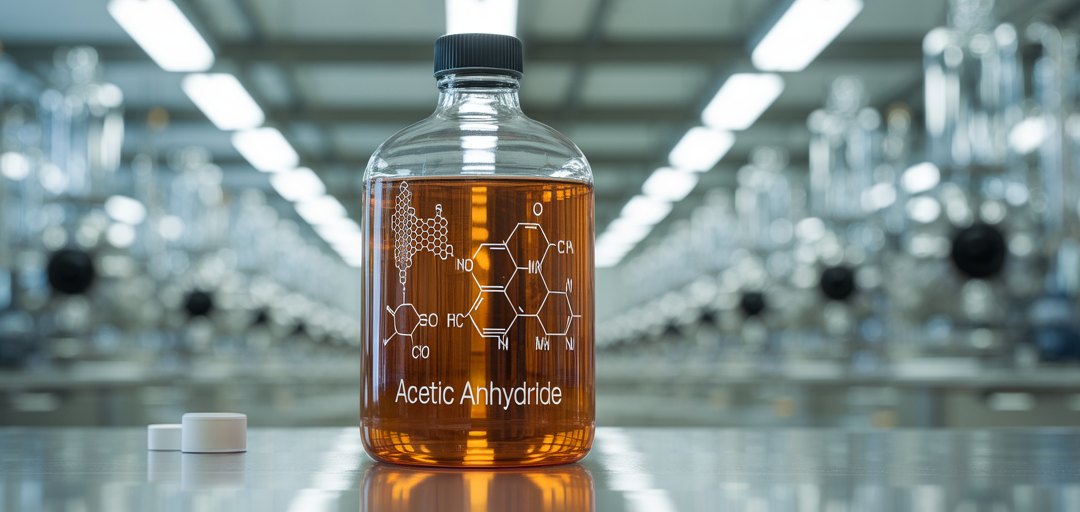
The Acetylation Agent That Changed Industries
If acetic acid is the kitchen’s chemical celebrity, acetic anhydride is its industrially potent cousin—less visible, more reactive, and absolutely indispensable. This colourless, pungent liquid is the world’s leading acetylating agent, transforming molecules across diverse sectors—from making aspirin to producing cellulose acetate, a foundational polymer for filters, textiles, and film.
Behind the scenes of countless consumer goods lies the silent work of acetylation—introducing acetyl groups to molecules to change their physical, chemical, or biological properties. Acetic anhydride (AAH) powers this transformation, bridging industries as diverse as pharmaceuticals, plastics, food additives, and even green chemistry innovations.
This article explores the versatile role of acetic anhydride, how it’s produced, where it’s applied, and what safety and regulatory considerations come with its reactive nature.
Chemical Overview: Properties and Production Pathways
Chemical identity
Formula: (CH₃CO)₂O
CAS Number: 108-24-7
Molecular weight: 102.09 g/mol
Appearance: Clear, colourless liquid with a strong, vinegar-like odour
Reactivity: Highly reactive with water (hydrolyses to acetic acid), alcohols, phenols, and amines
Industrial production methods
The two dominant production routes for acetic anhydride are:
| Process | Inputs | Summary | Major Producers |
|---|---|---|---|
| Ketene process | Acetic acid + heat | Acetic acid is dehydrated to form ketene, which reacts with more acetic acid to form acetic anhydride | Eastman, Celanese |
| Acetaldehyde oxidation | Acetaldehyde + acetic acid | Less common; used where aldehyde streams are cheap and available | Some Chinese plants |
Modern ketene plants use gas-phase cracking reactors operating at ~700°C, followed by controlled condensation. Eastman Chemical’s Kingsport, TN plant is among the world’s largest and most efficient producers.
Applications: The Wide World of Acetylation
Pharmaceuticals: From pain relief to antibiotics
Acetic anhydride is essential in synthesising acetylsalicylic acid, better known as aspirin. By acetylating salicylic acid, chemists increase its bioavailability and reduce gastric irritation. Global aspirin demand exceeds 30,000 tonnes annually, with India and China leading in API production.
Other uses in pharma include:
Paracetamol intermediates
Heroin (illicit use) – due to which it is tightly regulated
Cephalosporin antibiotics – acetylated intermediates in 2nd- and 3rd-gen molecules
Anti-inflammatory steroids (e.g., prednisone acetate)
Cellulose Acetate: The polymer backbone
Cellulose acetate, derived from natural cellulose and acetic anhydride, underpins multiple product categories:
Cigarette filters – over 90 % of global cellulose acetate goes into this use
Photographic film & textiles – used for its thermoplasticity and sheen
Bio-based plastics – a compostable alternative to petrochemical polymers
Membranes for filtration and separation in biotechnology and water purification
Large-scale manufacturers include Daicel, Eastman, and Mitsubishi Rayon. These operations consume hundreds of thousands of tonnes of acetic anhydride annually.
Food & fragrance: A surprising role
Although acetic anhydride itself is not used in food, its derivatives (e.g., modified starches and flavouring agents) are food-safe. In perfumery, acetylation helps create stable esters that deliver fruity, spicy, and woody aromas.
Green Chemistry & Sustainable Futures
Acetic anhydride is being re-evaluated in the context of green chemistry—not just as a petrochemical product, but as a tool for greener reactions.
Biobased anhydride: Still early, but promising
Research is ongoing to develop bio-acetic anhydride from:
Biomass-derived acetic acid + ketene
Bioreactor-driven acetyl-CoA conversions
The challenge is economic viability. As acetic anhydride reacts violently with water, producing it from aqueous fermentation streams is technologically tricky.
Process intensification
Some manufacturers are integrating reactive distillation and low-waste acetylation processes, reducing solvent use and cutting by-products. In pharmaceutical manufacturing, AAH enables solvent-free acetylation under mild conditions, improving atom economy.
Carbon impact & circularity
While acetic anhydride production is energy-intensive (due to ketene generation), some plants now use renewable energy inputs, and several are exploring carbon capture integration with acetic acid production loops.
Safety and Regulatory Landscape
Acetic anhydride’s reactive nature means strict handling and compliance protocols are vital.
Safety characteristics
| Risk Factor | Description |
|---|---|
| Flammability | Vapours form explosive mixtures with air (flash point: 49°C) |
| Corrosivity | Strongly irritates eyes, skin, and mucous membranes |
| Hydrolysis hazard | Reacts with water to release heat and acetic acid vapours |
| Storage | Store in stainless steel or polyethylene containers with nitrogen blanketing |
PPE requirements include chemical-resistant gloves, eye protection, face shields, and local exhaust ventilation.
Regulatory classifications
US DEA Schedule II precursor (due to use in heroin synthesis)
REACH (EU): Listed as a hazardous substance—strict volume reporting
GHS Labelling: Flammable liquid, serious eye damage, skin corrosive
HS Code: 29152400
Due to its dual-use nature (legal and illicit), many governments require permits for import, export, or large-scale domestic use. In India, AAH is under Narcotic Drugs and Psychotropic Substances Act controls for this reason.
Global Market Overview
Market size and projections
The global acetic anhydride market was valued at USD $5.9 billion in 2024, expected to grow at a CAGR of 5.4 %, reaching ~USD $8.5 billion by 2030.
| Region | Key Trends |
|---|---|
| Asia-Pacific | Largest and fastest-growing; driven by pharma and textiles in India and China |
| North America | Strong in cellulose acetate and aspirin production; Eastman is market leader |
| Europe | Stable demand in food/pharma; tighter REACH regulations are shaping sourcing |
Key producers
| Company | Country | Notable Assets |
|---|---|---|
| Eastman Chemical | USA | Largest global capacity (Kingsport site) |
| Celanese | USA | Integrated acetic acid/anhydride lines |
| Daicel Corporation | Japan | Vertical integration into cigarette filters |
| UFlex, Laxmi Organics | India | Expanding due to API and acetate markets |
Emerging Trends and Innovations
Micro-acetylation in biotech: Using AAH to selectively functionalise biopolymers for biomedical use
AI-driven reaction prediction: Optimising acetylation conditions to reduce waste and improve yield in pharmaceutical pipelines
Closed-loop manufacturing: Recovery and recycling of excess AAH in plant processes
Blockchain-traced precursors: Emerging interest in tracking precursor movement to avoid diversion for illicit uses
Challenges: Hazards and Headwinds
| Challenge | Impact |
|---|---|
| Illicit use concerns | Stricter regulation, supply chain vetting, import/export bottlenecks |
| Energy and cost volatility | Dependence on acetic acid and fossil fuel prices |
| Toxicity in waste | Effluent treatment compliance burdens for bulk producers |
| Decarbonisation | Lagging behind other acetyl products in green innovation adoption |
Conclusion: Acetic Anhydride’s Hidden Hand in Modern Chemistry
Often overshadowed by more visible compounds, acetic anhydride remains one of chemistry’s most versatile and vital reagents. From shaping therapeutics like aspirin to enabling bio-based plastics, its reach is both wide and deep. Yet its use comes with responsibility: precise handling, compliance with tight regulations, and now—an imperative to evolve toward greener, safer, and smarter acetylation pathways.
As the chemical industry embraces circularity and digitalisation, acetic anhydride may shift from being just a high-volume intermediate to a precision tool in the sustainable chemistry toolbox.